TamuCTF 2026 Writeups
nucleus [rev]
The challenge provided a binary nucleus21.exe. I tried running it, and it creates a new file nucleus22.exe after receiving input. I noted that the new file is larger.
First impression
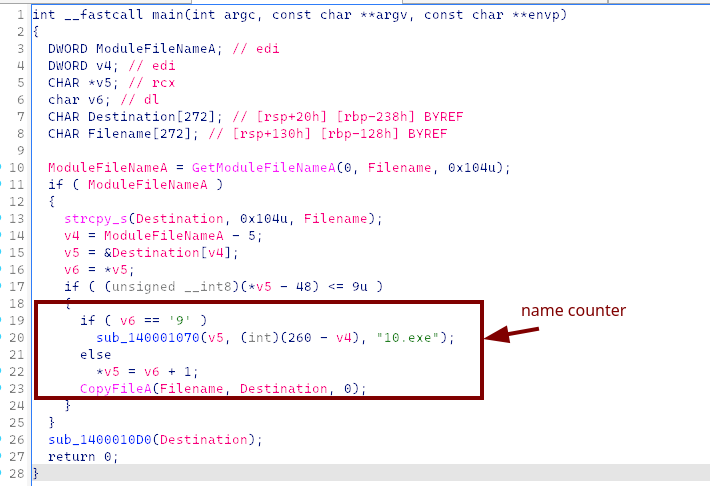
First, it makes a copy of itself (with a different index), and then sub_1400010D0 modifies that new copy.
Inside
Note that v7 holds a copy of the file.
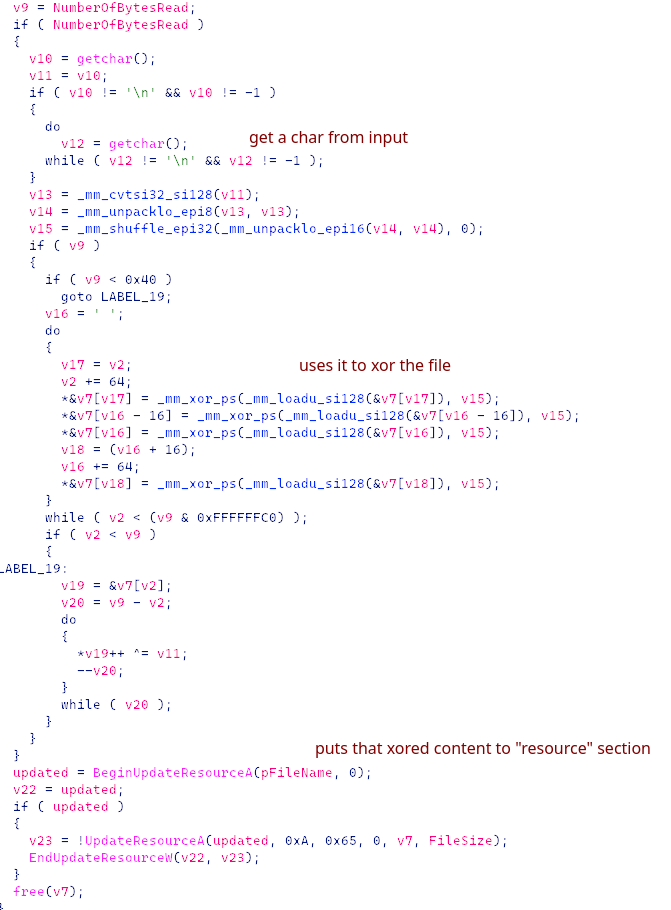
I guessed that the flag was fed to the nucleus in the form of 21 single bytes.
There are two things left to answer now:
- Address the “resource” - how do we extract it?
- How should we recover the bytes?
Solution
- By looking it up, I found that the resource section is
.rsrc. Claude generated an extraction script for me. - It XORed the entire binary file, which means the magic bytes also got XORed.
import pefile
from pwn import xor

flag = ""

for i in range(20, -1, -1):
	pe = pefile.PE(f"nucleus{i+1}.exe")
	for res_type in pe.DIRECTORY_ENTRY_RESOURCE.entries:
		if res_type.id == pefile.RESOURCE_TYPE['RT_RCDATA']:
			for res_id in res_type.directory.entries:
				if res_id.id == 101:
					for res_lang in res_id.directory.entries:
						data_rva = res_lang.data.struct.OffsetToData
						size = res_lang.data.struct.Size
						payload = pe.get_data(data_rva, size)
						key = payload[0] ^ ord('M')
						flag += chr(key)
						open(f"nucleus{i}.exe", "wb").write(xor(payload,key))

print(flag[::-1])
Flag
gigem{RCD4Ta_i5_N3aT}
challenge7 [rev]
The challenge provides a binary file challenge7 that validates an input.
After a quick scan, I caught these:
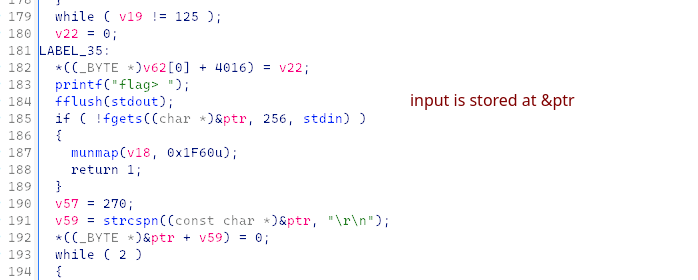
Then, the input stays untouched and gets passed to a JIT function compiled with some VM-like code.
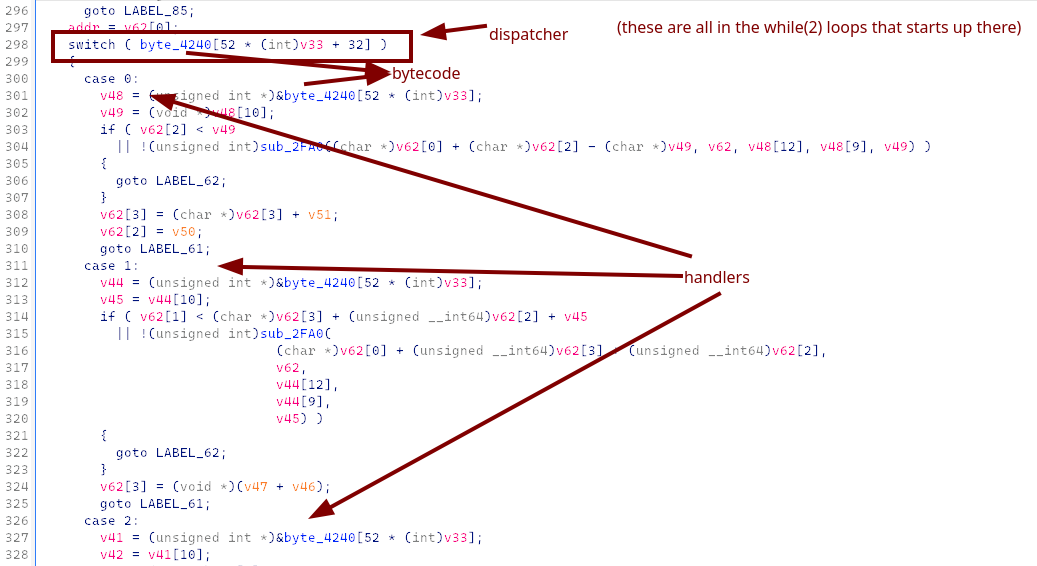
Scrolling down:
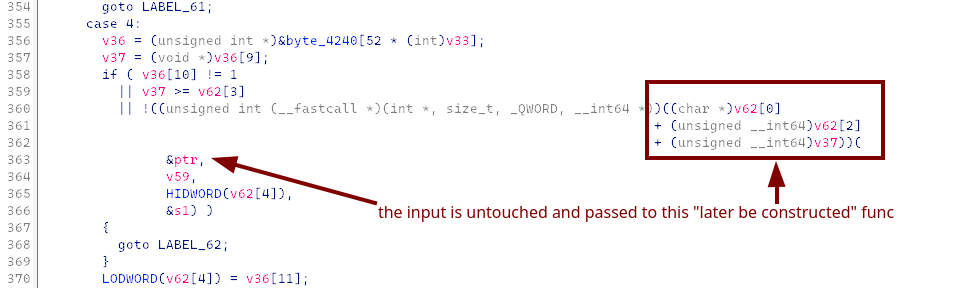
I think we should set a breakpoint there and dump out the validating function(s), eh? Let’s check for anti-debugging measures; there should be some standing in our way.
The hunt
outside the loop
I first found this:
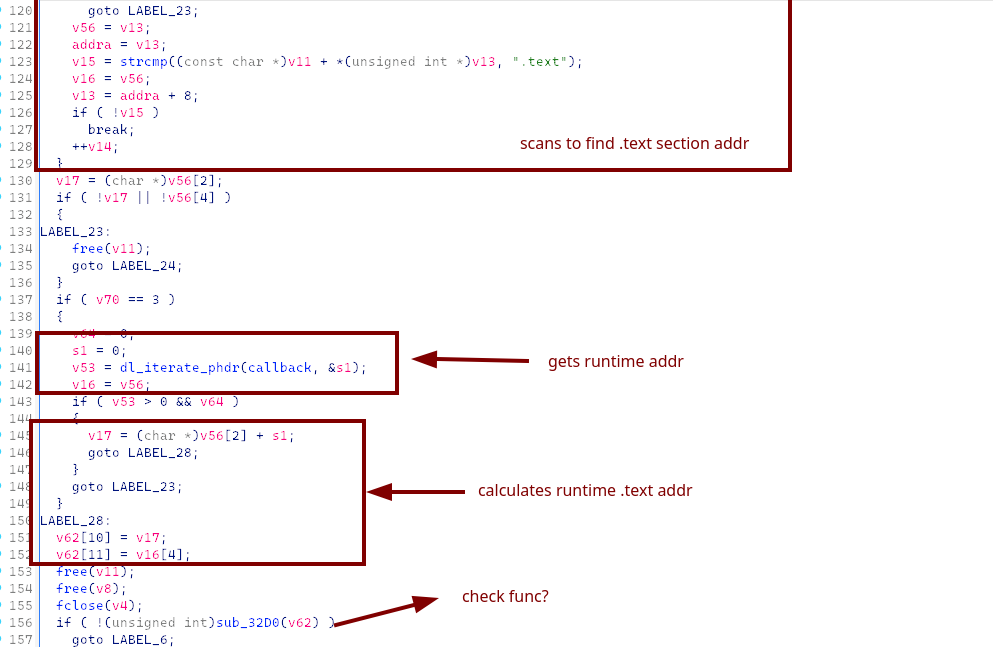
sub_32D0 appears at the start of the loop as well; let’s see what’s inside.
sub_32D0
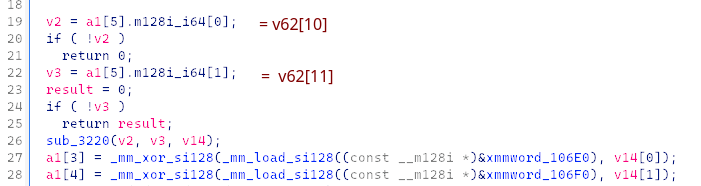
While inspecting xmmword_106E0, I found something familiar.
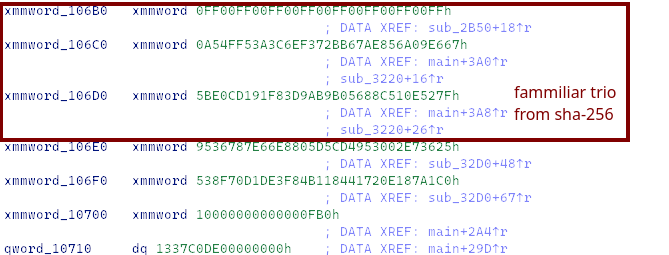

It matches xmmword_106E0. I concluded that sub_3220 is SHA-256, and from that, derived that sub_2B60 and sub_3010 are also part of the SHA-256 process (I’m going to rename them for later analysis).
If the hash passes, then a1[3] = a1[4] = 0.
The rest of this check function is just a debugger check (iPrecarT :d) and a hook check (LD_PRELOAD): it corrupts a1[3] and a1[4] if there is anything suspicious.
We can conclude that sub_32D0 sets v62[6] = ... = v62[9] = 0 (if things run normally).
With that finding, I just need to keep an eye out for anything that touches v62[6:10], and also v62[10:12] because they hold information about the runtime .text section.
inside the loop
I found just this one:
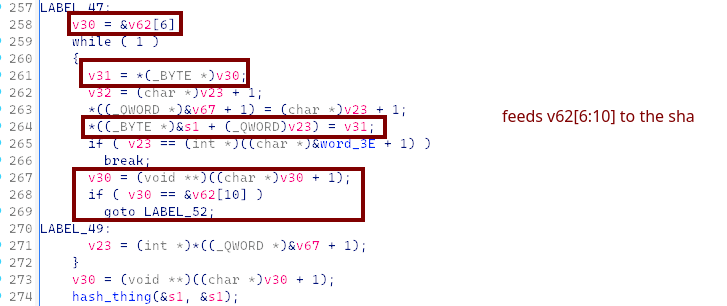
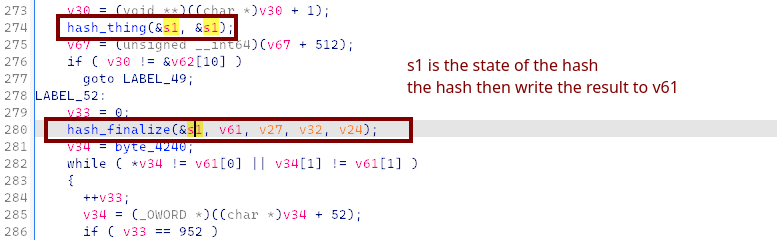
The other parts are just VM things; it feeds the VM state into those hashes too. I guess we don’t need to touch them (reading all that makes me feel dizzy as hell, nah).
Patching
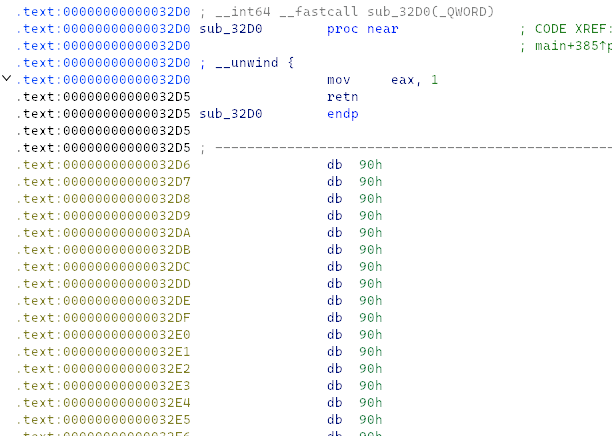
I gathered that we just need to patch sub_3220 so it doesn’t screw up our v62.
hmmmmmmm…..
“Hey Claude, nop-nuke this shit for me (remember to return 1).”
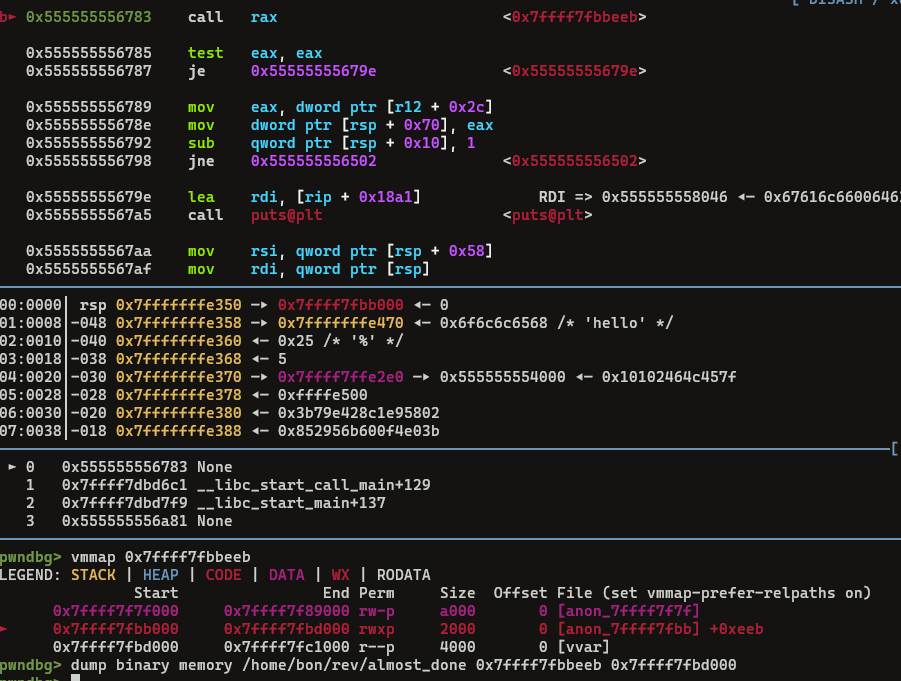
Found one, dumped it.
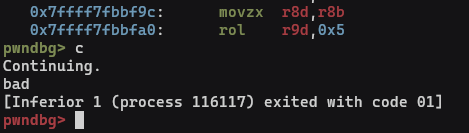
There seems to be just one flag_check func.
Finishing
The dumped function looks legit. I decompiled it in IDA. Note that:

And I got the reverse script:
def ror4(x, n): return ((x >> n) | (x << (32-n))) & 0xFFFFFFFF
def rol4(x, n): return ((x << n) | (x >> (32-n))) & 0xFFFFFFFF

expected_v18 = {}
for i in range(0, 8): expected_v18[i] = (0x2b48b515d43f4140 >> (i*8)) & 0xFF
for i in range(8, 16): expected_v18[i] = (0x35bcb75507c270f7 >> ((i-8)*8)) & 0xFF
for i in range(16, 24): expected_v18[i] = (0x841e959c29c8f1e7 >> ((i-16)*8)) & 0xFF
for i in range(24, 32): expected_v18[i] = (0x1e7c68fc9ce020c2 >> ((i-24)*8)) & 0xFF
for i in range(32, 37): expected_v18[i] = (0x000000daf7d998de >> ((i-32)*8)) & 0xFF
expected =[expected_v18[i] for i in range(37)]

v6 = 0x1337c0de ^ 0xc0def00d
v10 = 0; v9 = 0
flag_chars =[]; all_ok = True

for i in range(37):
	tmp = (v6 + v10 - 0x61c88647) & 0xFFFFFFFF
	next_v6 = (rol4(tmp, 5) ^ ror4(tmp, 3)) & 0xFFFFFFFF
	r10d = (next_v6 >> 8) & 0xFFFFFFFF
	ecx_add = (((next_v6 >> 16) & 0xFFFFFFFF) + v9) & 0xFF
	A = (i*17 ^ next_v6 ^ r10d) & 0xFF
	needed = (expected[i] - ecx_add) & 0xFF

	flag_chars.append((A ^ needed) & 0xFF)
	v6 = next_v6
	v10 = (v10 + 0x45d9f3b) & 0xFFFFFFFF
	v9 = (v9 + 0xb) & 0xFFFFFFFF

flag_inner = ''.join(chr(c) for c in flag_chars)
print(f"gigem}")
Flag
gigem{this_will_be_the_flag_for_challenge_7}
war-hymn [rev]
Inspecting main, I found a repeating pattern like this:
v = ...
if debugger_present():
	corrupt(v)

new_v = b''
for i in range(len(v))
	new_v += v[i] ^ (xmmword_403070[i] + 21)
After 1 or 2 blocks like that, it feeds the decrypted strings to another function.
I began by checking the code around the first two decodes:
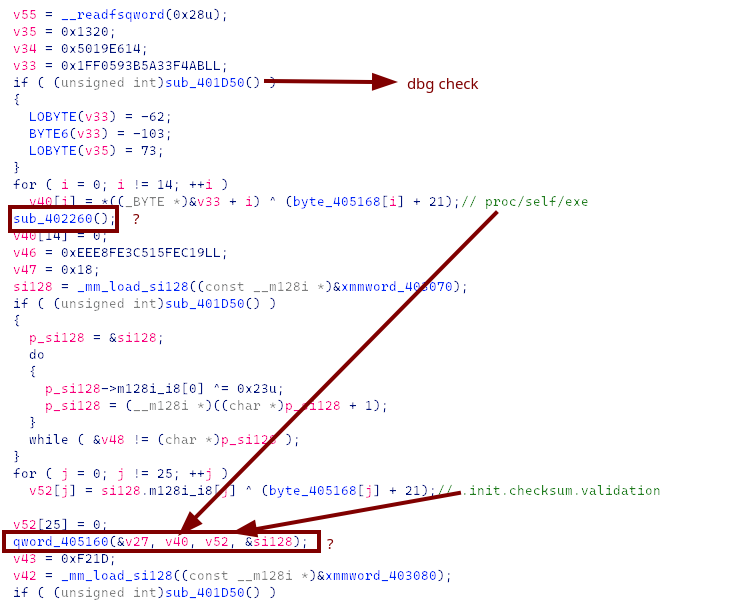
sub_402260 & qword_405160
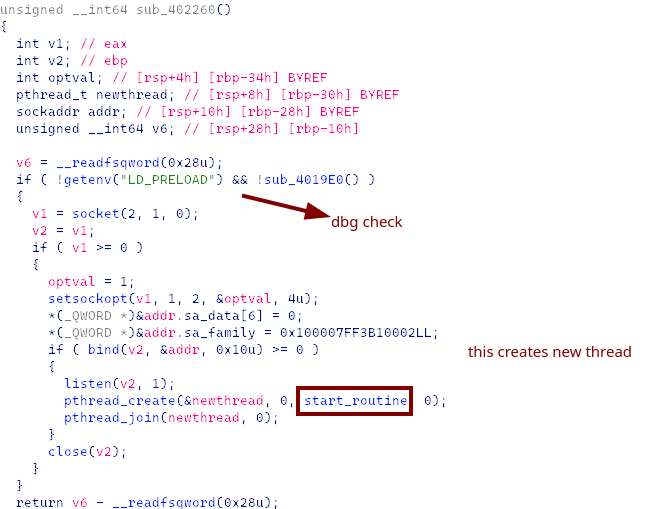
Checking the routine:
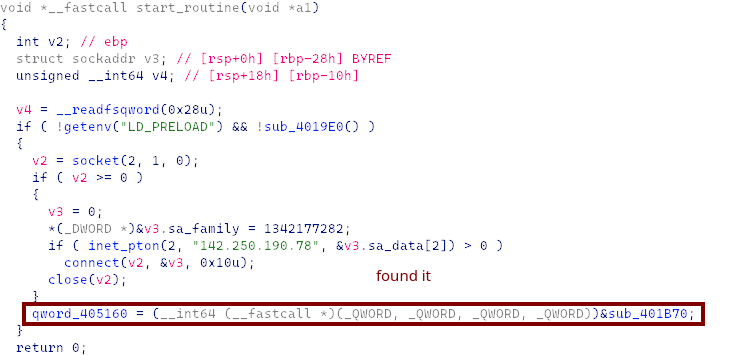
Keeping going, note that:
qword_405160(v27, v40, v52)
v40 = proc/self/exe
v52 = .init.checksum.validation
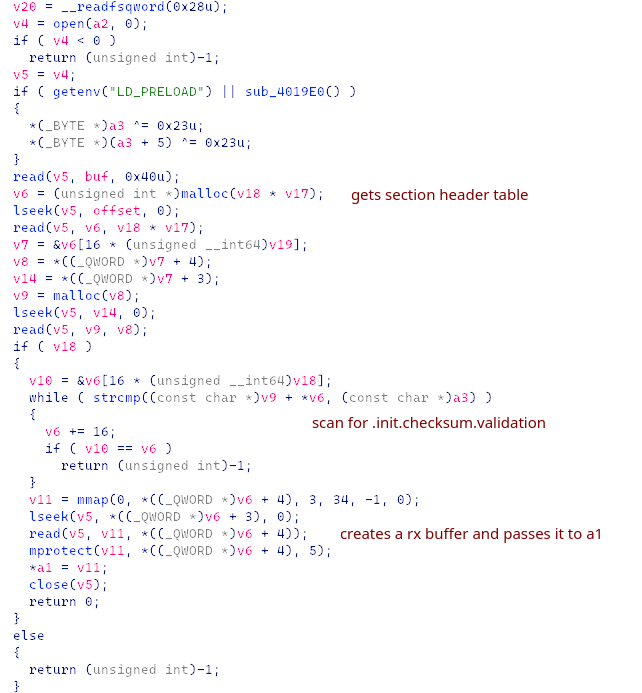
jump back to main
The next strings are .bss.secure.buffer and .init.constructors.global, which get passed to sub_401D90.
sub_401D90 also scans for the data section. It passes the found section pointer to the second argument and assigns the length to the third argument.
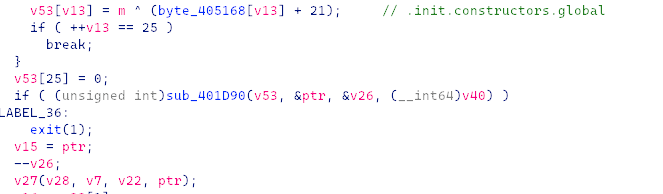
Everything is then fed to the function in v27, holding the .init.checksum.validation section. I guess now we need to find out what that was.
Dumping
Speaking of ELF sections, let’s use readelf to see where they live.
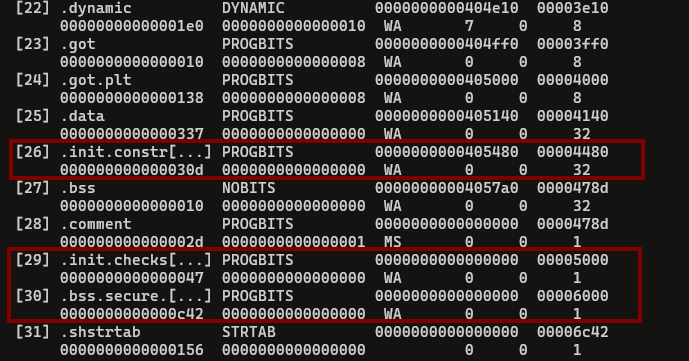
It calls a function at .init.checksum.validation, so I dumped that section:
data = open("war-hymn", "rb").read()[0x5000 : 0x5000 + 0x47]
open("init_constructors_global.bin", "wb").write(data)
and put it in IDA:
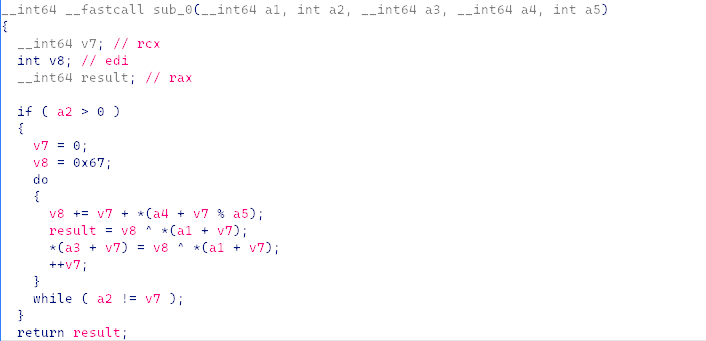
a1: encrypted data ptr, a2: data len, a3: dest, a4: key ptr, a5: key len
This takes 5 args, but the pseudocode showed just 4. Let’s check the ASM in main again:
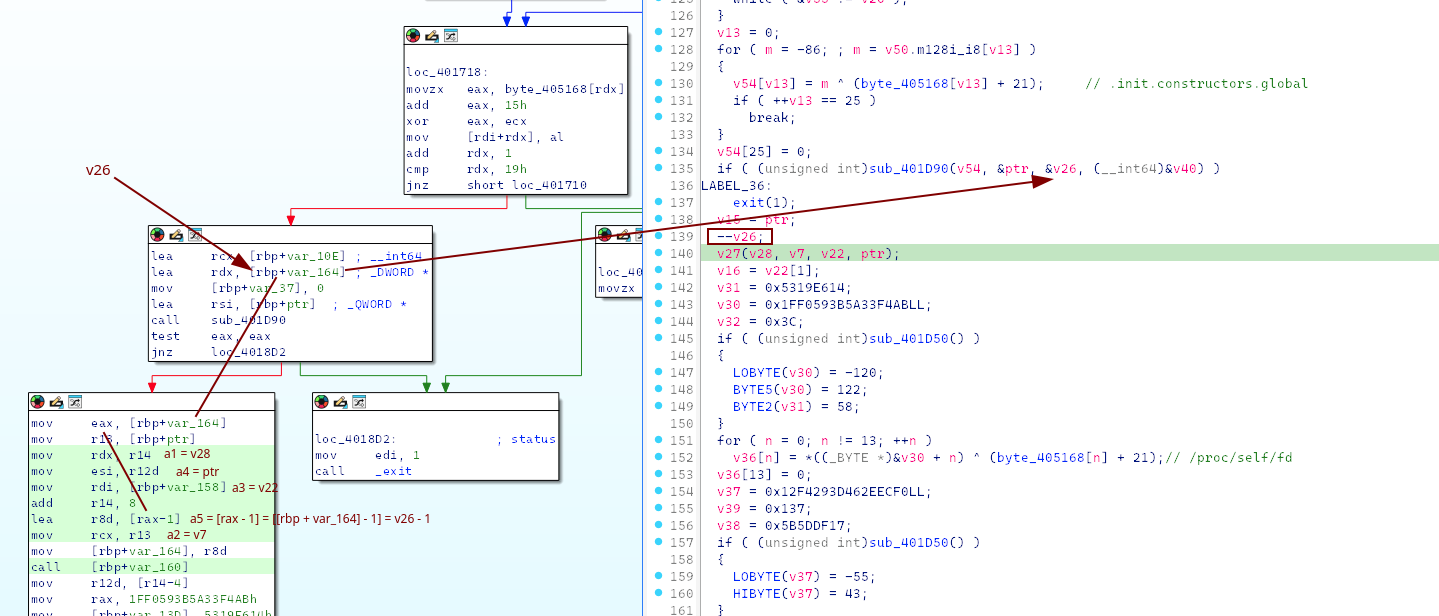
So this should be the correct replication:
with open('war-hymn','rb') as f:
	d = f.read()

ctor_key = d[0x4480:0x4480+0x30d]
bss = d[0x6000:0x6000+0xc42]

def decrypt_checksum(src, key, key_len, init_acc=0x67):
	acc = init_acc
	out = bytearray()
	for i, b in enumerate(src):
		idx = i % key_len
		val = key[idx] + i
		acc = acc + val
		out.append(b ^ (acc & 0xff))
	return bytes(out)


dec = decrypt_checksum(bss, ctor_key, 0x30d-1)
open('decrypted_thing','wb').write(dec)
I was curious, so I threw it into DiE and ImHex:
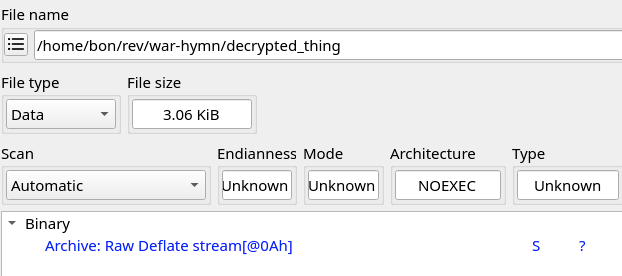
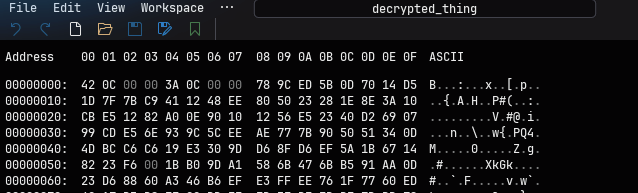
Jackpot. That 78 9C are the magic bytes of zlib.
Later analysis of sub_4020D0 -> sub_401F90 also confirms that there is some sort of inflating (decompression).
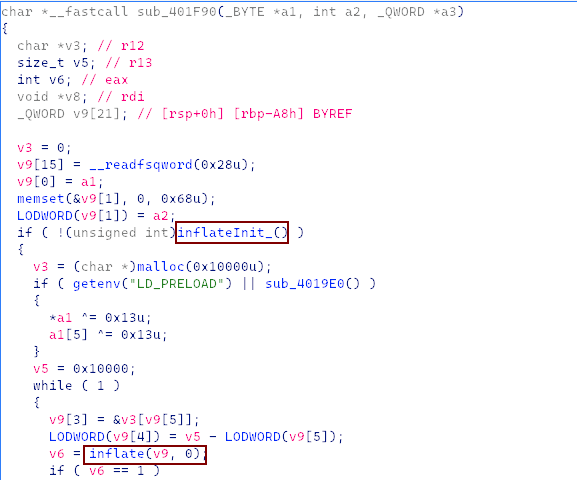
Let’s decompress it and see what it holds:
import zlib

compressed = open("decrypted_thing", "rb").read()
#
decompressed_data = zlib.decompress(compressed[8:])
open("is_this_final", "wb").write(decompressed_data)
Last file to analyze
The decompressed binary has some functions as follows:
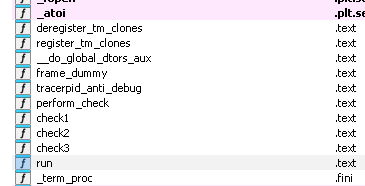
run is the entry point. Now things are in plain sight.
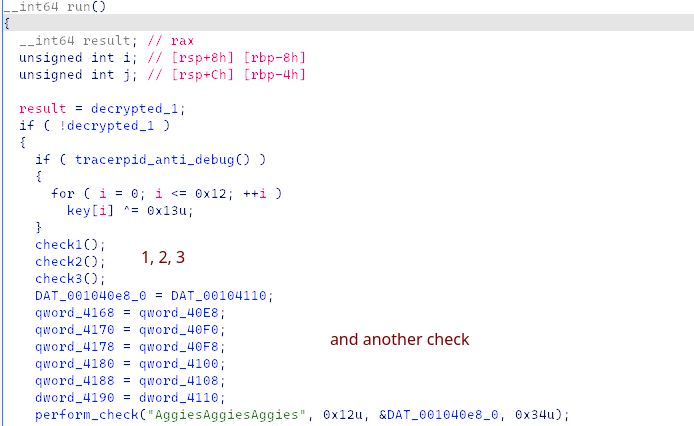
file = open('is_this_final','rb').read()

def rc4(key, data):
	# rc4 implement here
	return bytes(out)

key = b'AggiesAggiesAggies'

data1 = file[0x3080:0x3080+0x12]
dec1 = rc4(key, data1)

data2 = file[0x3098:0x3098+0x0f]
dec2 = rc4(key, data2)

data3 = file[0x30b0:0x30b0+0x11]
dec3 = rc4(key, data3)

dat4110 = file[0x30e0:0x30e0+0x34]
dec4 = rc4(key, dat4110)
Flag
gigem{sh0uld_h4v3_r4n_th3_b411_0n_f1r$t_4nd_g04l!!!}