HTB - callfuscated
They give us an ELF file

I put it in IDA and analyze:
de-callfuscating
This binary is filled with many trampoline jumps.
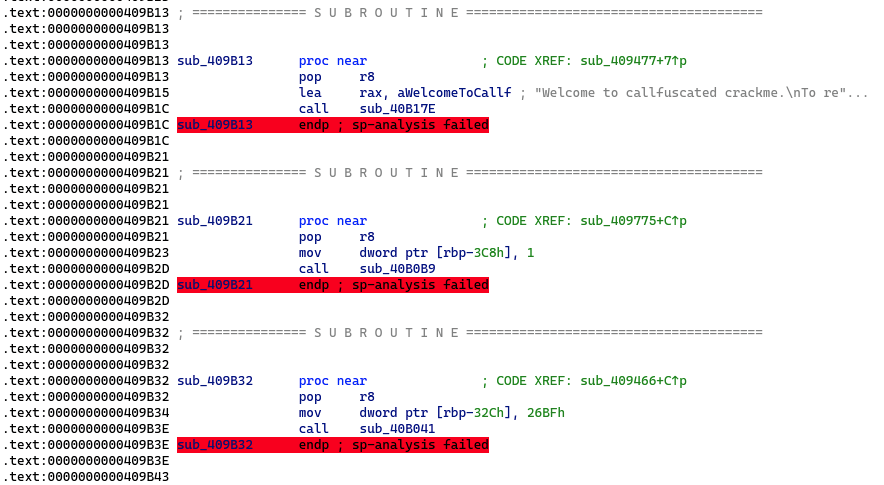
Scrolling through, the obfuscation pattern is:
call next_block

next_block:
	pop r8
	<real instruction>
	call another_block
Note that the call instruction does two things:
- pushes addr of the next instruction onto the stack
- and jumps to the target.
The pop r8 discards the return address from the stack, allowing the program continue linearly
The obfuscate algo is equivalent to this clean logic:
jmp next_block

next_block:
	<real instruction>
	jmp another_block
The following script nop-ed the pop r8 and patched call to jmp .
import struct
import sys

BASE = 0x400000

def target_of_call(buf, off):
    rel = struct.unpack_from("<i", buf, off + 1)[0]
    return BASE + off + 5 + rel


buf = bytearray(open('crackme', "rb").read())

for off in range(len(buf) - 5):
	if buf[off] != 0xE8:
		continue

	target = target_of_call(buf, off)
	target_off = target - BASE

	if 0 <= target_off < len(buf) - 1 and buf[target_off : target_off + 2] == b"\x41\x58":
		buf[off] = 0xE9
		buf[target_off : target_off + 2] = b"\x90\x90"

open('patched_crackme', "wb").write(buf)
print("done")
a vm awaits
IDA handled the jmp and got me this clean pseudocode.
It seems this is VM-obfuscated
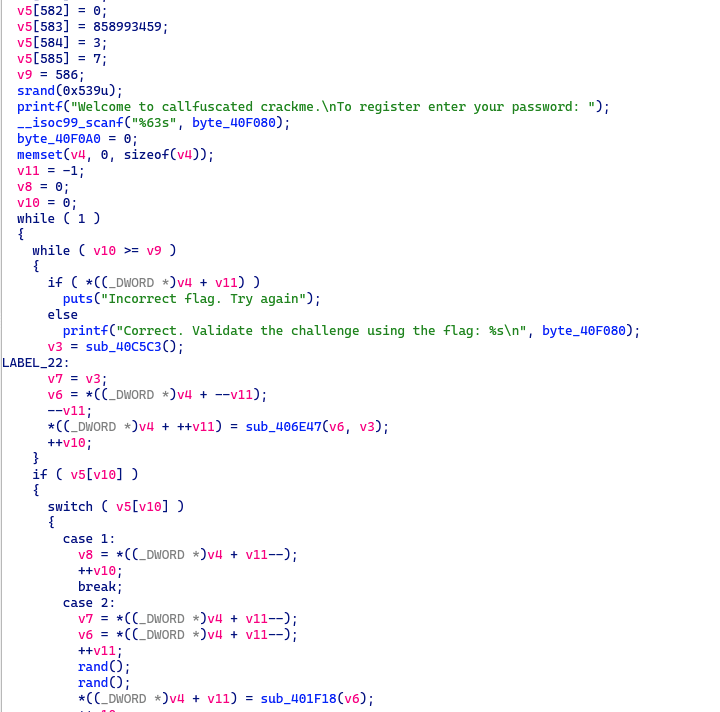
and the VM handlers are heavily MBA-obfuscated
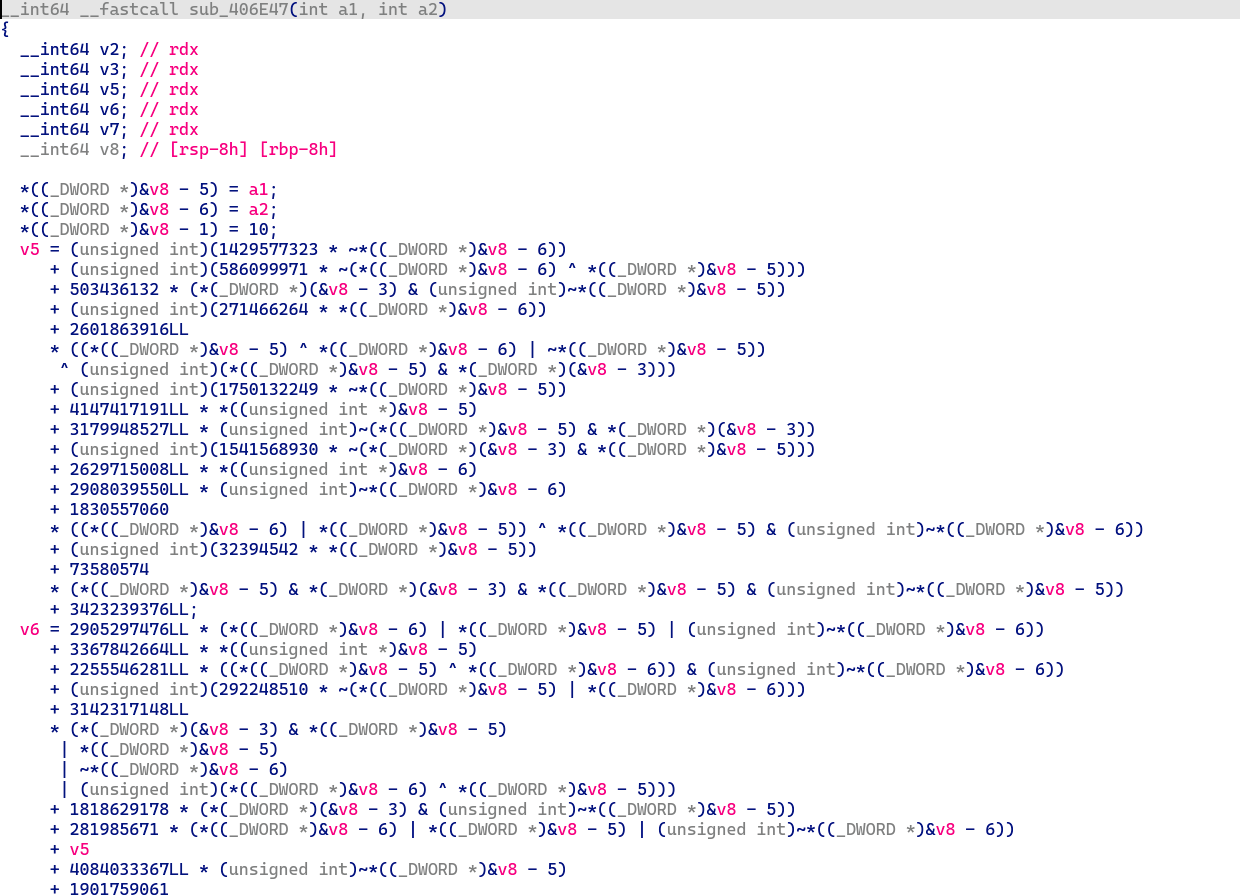
In this case, i’ll guess its semantics by sampling some pairs (7,3), (11,6), (16,4). These are the pairs that produce unique, distinguishable outputs for each common arithmetic and bitwise operation.
Deduced that:
sub_401F18~ addsub_4050AA~ subsub_401166~ mulsub_4080D6~ andsub_406E47~ orsub_405C1F~ xor
vm reversal
I began by dumping the bytecode.
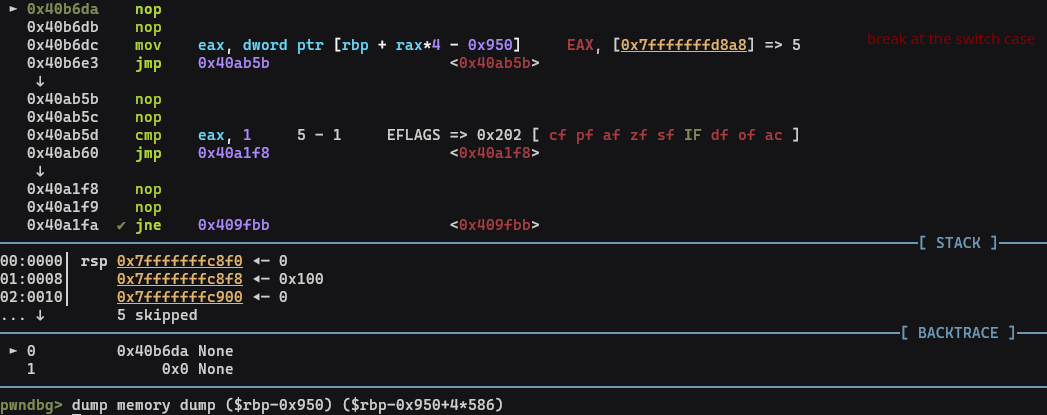
Then, i replicate the VM behavior
import struct
import sys


INPUT_BASE = 0x40F080


def u32(x):
    return x & 0xFFFFFFFF


def hx(x):
    return f"0x{u32(x):08x}"


def pop2(stack):
    b = stack.pop()
    a = stack.pop()
    return a, b

password = "A"*64
data = open("dump", "rb").read()
code = list(struct.unpack("<" + "I" * (len(data) // 4), data))[:0x24A]
mem = {INPUT_BASE + i: c for i, c in enumerate(password.encode() + b"\x00")}

stack = []
pc = 0

while pc < len(code):
    ip = pc
    op = code[pc]
    pc += 1

    if op == 0:
        val = code[pc]
        pc += 1
        stack.append(val)
        msg = f"PUSH {hx(val)}"

    elif op == 1:
        val = stack.pop()
        msg = f"POP {hx(val)}"

    elif op == 2:
        a, b = pop2(stack)
        stack.append(u32(a + b))
        msg = f"ADD {hx(a)} + {hx(b)}"

    elif op == 3:
        a, b = pop2(stack)
        stack.append(u32(a - b))
        msg = f"SUB {hx(a)} - {hx(b)}"

    elif op == 5:
        a, b = pop2(stack)
        stack.append(u32(a * b))
        msg = f"MUL {hx(a)} * {hx(b)}"

    elif op == 6:
        a, b = pop2(stack)
        stack.append(u32(a & b))
        msg = f"AND {hx(a)} & {hx(b)}"

    elif op == 7:
        a, b = pop2(stack)
        stack.append(u32(a | b))
        msg = f"OR  {hx(a)} | {hx(b)}"

    elif op == 8:
        a, b = pop2(stack)
        stack.append(u32(a ^ b))
        msg = f"XOR {hx(a)} ^ {hx(b)}"

    elif op == 9:
        addr = code[pc]
        pc += 1
        stack.append(mem.get(addr, 0))
        msg = f"LOAD_ABS [{addr:#x}]"

    elif op == 10:
        addr = stack.pop()
        val = mem.get(u32(addr), 0)
        stack.append(val)
        ch = f" '{chr(val)}'" if 32 <= val <= 126 else ""
        msg = f"LOAD_PTR [{u32(addr):#x}] -> {val:#x}{ch}"

    else:
        print(f"{ip:04d}: unknown opcode {op:#x}")
        break

    top = hx(stack[-1]) if stack else "<empty>"
    print(f"{ip:04d}: {msg:<35} top={top} stack_depth={len(stack)}")

print()
if stack:
    print(f"final top = {hx(stack[-1])}")
    print("Correct" if u32(stack[-1]) == 0 else "Incorrect")
else:
    print("empty stack")
Analyzed the log:
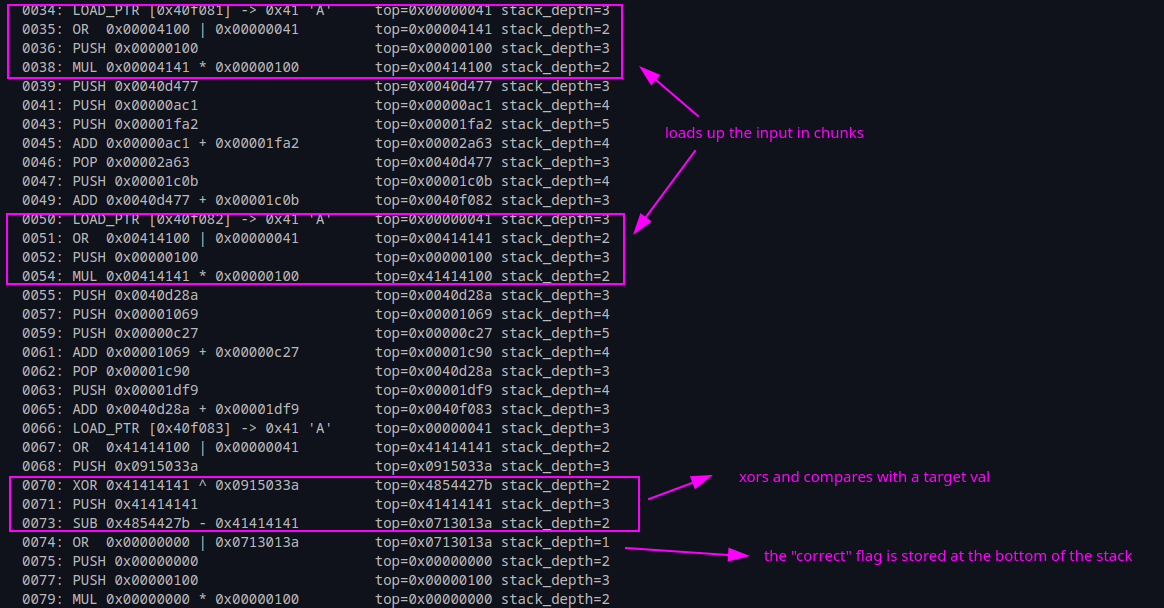
Retrieve the stored xoring values from the dump and we are done
print(bytes.fromhex(hex(0x0915033a ^ 0x41414141)[2:]
                    + hex(0x427d7872 ^ 0x11111111)[2:]
                    + hex(0x30310a00 ^ 0x55555555)[2:]
                    + hex(0x2a052e32 ^ 0x5a5a5a5a)[2:]
                    + hex(0xcff5ecdf ^ 0xaaaaaaaa)[2:]
                    + hex(0x1914031e ^ 0x77777777)[2:]
                    + hex(0xf6f7c6ad ^ 0x99999999)[2:]
                    + hex(0x6c6a524e ^ 0x33333333)[2:]))
flag
nice challenge
HTB{Sliced_Up_the_Function_4_Ya}